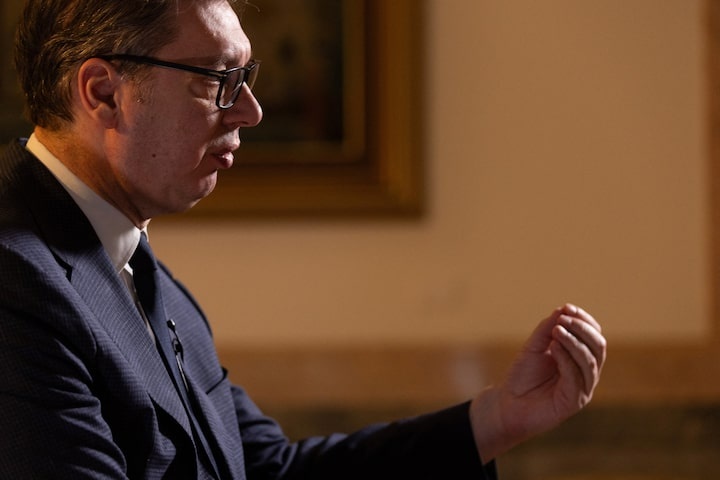

Serbia’s Security and Information Agency (BIA) officially advised President Aleksandar Vucic not to travel to Montenegro on Friday, June 5, for the EU–Western Balkans Summit in the coastal town of Tivat, citing a “high security risk.” The warning, issued late on Wednesday, came hours after Montenegrin authorities turned back a charter flight carrying 87 Serbian passengers they had deemed a security threat. Vucic said he intends to attend regardless.
French President Emmanuel Macron, German Chancellor Friedrich Merz, and European Commission President Ursula von der Leyen are due to arrive in Tivat on Friday to meet leaders of the six Western Balkan countries and discuss progress towards EU membership. The summit is one of the most high-profile gatherings of European leaders on the continent this week.
The BIA said in its statement: “According to our operational intelligence, Radoje Zvicer, the leader of the Kavač clan, is currently in Montenegro.” The Kavač clan is one of the most violent organised crime networks in the Western Balkans, with a documented record of assassinations and cross-border criminal activity.
The full BIA statement read: “Due to hostile actions by foreign services and criminal clans in Montenegro, the Security and Information Agency has officially advised the President of the Republic of Serbia not to travel to Montenegro, as a high security risk has been determined.”
The agency also said that “contrary to all professional standards and principles of responsible conduct, the security assessment that was repeatedly requested from the host country’s service in Montenegro has not been provided to us.”
Vucic’s own parliamentary speaker confirmed he would not heed the warning. Serbian Parliament Speaker Ana Brnabic said she had tried to persuade Vucic to abandon the trip but that “he does not even want to hear about it.” She added that Vucic would likely travel with a significantly reduced security detail — “I don’t think more than seven people from his security will be able to travel with him,” she said. Brnabic said the president was determined to go “due to his duty to Serbia,” she told Serbian media.
Montenegro’s government pushed back directly against the BIA’s framing. The Montenegrin Ministry of Foreign Affairs posted on X that Montenegro would do everything to “receive our friends, allies, and partners at the highest level and ensure the successful and dignified holding of this important international event for us.” The ministry added: “As a responsible and credible NATO member, Montenegro guarantees all its guests a safe, secure, and pleasant stay.”
The charter flight incident that preceded the security warning added a sharper edge to the diplomatic standoff. A charter flight carrying 87 passengers from Belgrade was returned from Tivat to Serbia on Wednesday after Montenegrin police and the National Security Agency assessed the group as a security threat. Montenegrin portal Vijesti reported that the returned passengers “largely have criminal records” and have been mentioned in Serbian media as persons tasked with “special assignments by the SNS regime.” According to European Western Balkans, the individuals were reportedly carrying telecommunications equipment and banners bearing the slogan “Serbia is winning” — the counter-slogan used by President Vucic’s Serbian Progressive Party (SNS) against the student protest movement that has gripped Serbia in recent months.
Belgrade appeared to respond in kind. On Wednesday evening Serbia introduced stricter controls at its border with Montenegro, which created long lines at crossings, Serbian N1 TV reported. N1 also reported that a group of passengers from Montenegro were prevented from crossing into Serbia and that a flight from Podgorica was subjected to an unexpected security check, in what appeared to be a retaliatory measure by Belgrade.
Regional and Global Impact
The turbulence surrounding the summit lands at a delicate moment for EU enlargement policy in the Western Balkans. Relations between Serbia and Montenegro have been strained over Podgorica’s ties with Kosovo, which Serbia does not recognise, and Belgrade’s influence over domestic political issues through church and political parties affiliated with Vucic’s Serbian Progressive Party. The public clash between two neighbouring states — both nominally pursuing EU integration — creates an awkward backdrop for a summit designed to showcase European unity around the region’s accession path.
NATO member Montenegro gained independence in 2006 following the dissolution of its union with Serbia. Unlike Belgrade, Podgorica has introduced sanctions against Russia, aligning its foreign policy with the European Union. That divergence has deepened mutual suspicion between the two governments over recent years.
Background
Serbia and Montenegro share deep historical and cultural ties but have had a contentious relationship since Montenegrin independence in 2006. Montenegro joined NATO in 2017 over strong objections from Belgrade and from Russia, which views the Western Balkans as a zone of strategic competition with the West. Serbia has not imposed sanctions on Russia following its February 2022 invasion of Ukraine and has not applied to join NATO. The Kavač clan, named by BIA as the specific threat in Montenegro, is a criminal network that emerged from a split in Montenegro’s Škaljari organised crime group and has been linked to murders across Europe. The EU–Western Balkans Summit is a recurring forum for leaders to assess progress on EU membership negotiations.
What Happens Next
The EU–Western Balkans Summit is scheduled to proceed in Tivat on Friday, June 5, with or without Vucic’s full security detail. According to Reuters, Vucic plans to attend and hold bilateral meetings on the margins. The Independent Office for Police Conduct’s investigation into the charter flight incident is expected to continue, according to European Western Balkans. Montenegro’s government has pledged to guarantee the safety of all guests. No formal statement has been issued by EU institutions on the bilateral tensions between Belgrade and Podgorica ahead of the summit.