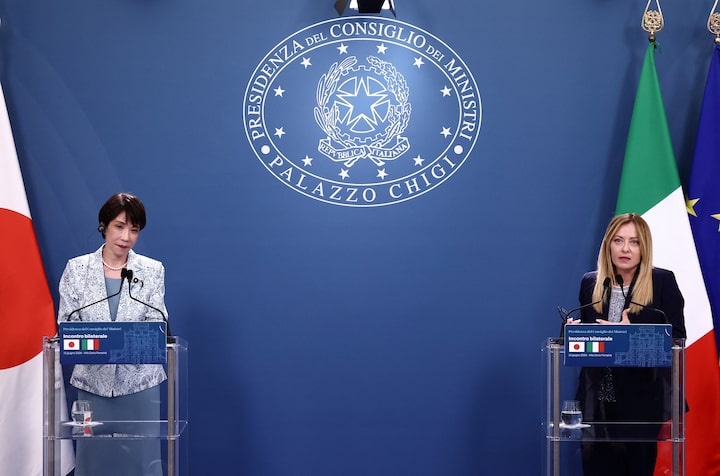

Japanese Prime Minister Sanae Takaichi expressed public support on Monday for Italy’s long-stalled plan to build a bridge across the Strait of Messina, calling on the project to move forward as a symbol of bilateral economic cooperation. Takaichi made the statement in Rome after holding talks with Italian Prime Minister Giorgia Meloni at the 17th-century Villa Doria Pamphili on June 15, 2026. The show of support came just days after Roman prosecutors opened a corruption investigation into the project, deepening the legal and financial cloud already hanging over it.
“I sincerely hope that the construction project for the Messina Strait Bridge, in which Japanese companies are participating, will become a landmark project symbolizing economic cooperation between our two countries,” Takaichi said, according to Reuters. She added: “I also hope that Japan’s expertise and experience will contribute to its early realisation.”
The bridge, if built, would span 3.7 kilometres (2.3 miles) and connect the Sicilian city of Messina to the Italian mainland — ending the island’s reliance on ferries for both passenger vehicles and freight trains. The project is led by the Eurolink consortium, which includes Italy’s largest construction group Webuild, Japan’s engineering firm IHI, and Spain’s Sacyr, Reuters reported.
But the project is far from ready to break ground.
Italy’s Court of Auditors declined to approve it last year, citing concerns about whether its procurement process met European Union competition rules. The court also flagged the dramatic difference between the original 2005 tender price of €3.8 billion and the current cost estimate of approximately €13.5 billion — a figure that has grown more than threefold over two decades. Then, last week, prosecutors in Rome announced they had opened a corruption investigation into the bridge, according to Reuters, adding a new legal obstacle to an already burdened project.
Environmental and seismic objections have compounded the delays. Critics argue the structure poses unacceptable risks in an earthquake-prone region, and that its construction could cause lasting environmental damage to the strait.
Meloni’s government has pushed back against those concerns. Her administration argues that better road and rail links between Sicily and the mainland are essential to driving economic growth in Italy’s historically underdeveloped south. Sicily currently depends on ferries, which carry both cars and train carriages across the water — a bottleneck that Meloni’s coalition has long said holds back the region.
The Rome meeting between Takaichi and Meloni covered more than infrastructure. Bloomberg reported that the two leaders also reaffirmed their commitment to the Global Combat Air Programme (GCAP), a trilateral next-generation fighter jet project involving Japan, Italy, and the United Kingdom. Meloni said the joint venture had “now finally entered its operative phase,” while Takaichi said the two countries would “continue to work together to accelerate the GCAP project.”
The summit took place ahead of the Group of Seven (G7) leaders’ summit in Evian, eastern France, which began on June 15 and runs through June 17, and which both Takaichi and Meloni are attending.
It was Takaichi’s first visit to Europe since taking office in late 2025, according to The Japan Times. The trip also marked a reciprocal meeting: Meloni had visited Tokyo in January 2026 and asked Takaichi to come to Italy during the 160th anniversary year of formal diplomatic ties between the two nations.
Regional and Global Impact
Japan’s open backing for the Messina bridge carries weight because of IHI’s role in the Eurolink consortium — Tokyo’s endorsement ties the project’s international credibility to Japanese engineering prestige. For the Meloni government, foreign prime ministerial support offers useful political cover as it faces mounting domestic and judicial scrutiny over a flagship infrastructure pledge.
The corruption probe, however, creates a significant complication. Italian prosecutors have not specified the targets or the precise scope of the investigation, but its existence means the project could face court-ordered delays or orders to halt procurement activity while the inquiry proceeds. The Court of Auditors’ prior refusal to register the project also means the government cannot disburse public funds for construction without a further legal resolution.
For Italy’s south, the stakes are real. If completed, the bridge would be one of the longest suspension bridges in the world and would dramatically cut transport times between Sicily and northern Italy. For Japanese companies like IHI, a successful delivery would represent a major international infrastructure win. If the project collapses — a real possibility given the mounting legal headwinds — both countries stand to lose sunk costs and diplomatic capital.
Background
The Messina Strait Bridge has been debated in Italy for decades, first appearing in serious planning discussions in the 1990s. A consortium was originally selected through a tender in 2005, when the project was priced at €3.8 billion. That effort eventually collapsed, and the project was revived under Meloni’s government after she took office in October 2022. The Eurolink consortium — including Webuild, IHI, and Sacyr — was designated to lead the project under the revived plan. Italy’s Court of Auditors blocked approval in 2025 over EU procurement compliance doubts. The corruption investigation announced in the week of June 8, 2026 by Rome prosecutors represents the most recent legal challenge.
What Happens Next
Both Takaichi and Meloni are attending the G7 summit in Evian, France, from June 15 to 17, where bilateral issues including trade and defence cooperation are expected to continue on the margins. Italy’s government must address the Court of Auditors’ concerns about EU competition compliance before it can secure formal approval to proceed with construction. Roman prosecutors’ corruption investigation will continue independently and could produce formal charges or requests for interim court orders that further delay procurement. No construction start date has been confirmed by either government.