
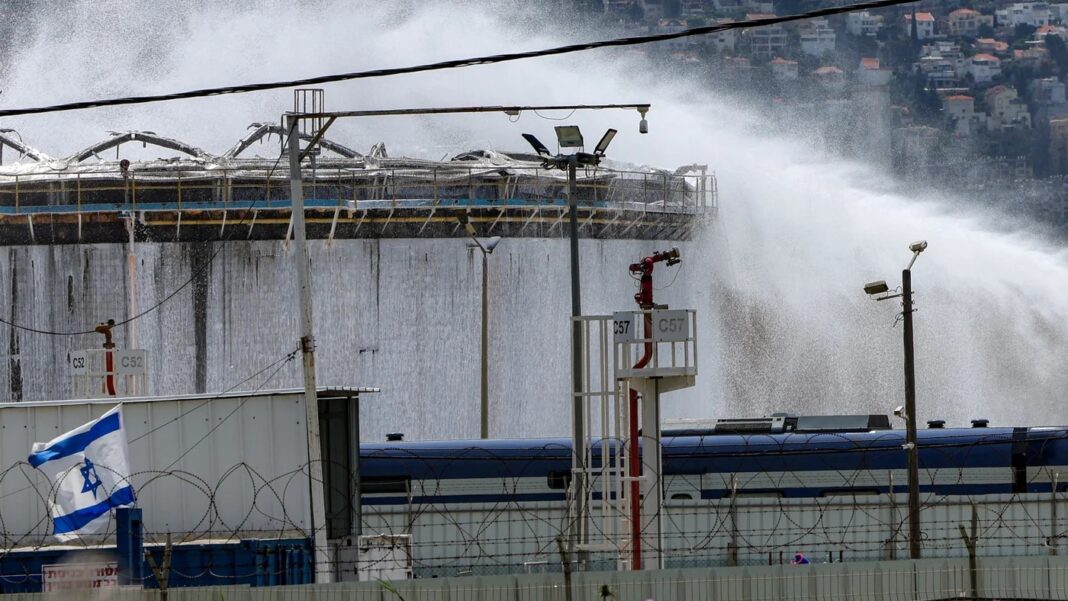

Israel’s largest oil refinery complex sustained far heavier damage from Iranian missile strikes than government officials and the operating company publicly acknowledged, according to an Interior Ministry document reported by Israel’s Channel 12 News on Monday, June 30. The document, published as part of procedures to approve reconstruction work at the Bazan refinery complex in Haifa Bay, details damage to gas turbines, steam boilers, electrical rooms and other auxiliary systems that had not previously been publicly reported. Full reconstruction is not expected to be completed until 2028.
The document concludes that the damage affects “essential operational and storage components” within one of Israel’s most important energy facilities, requiring years of reconstruction while maintaining production and fuel supplies. That assessment directly contradicts the public statements made by officials at the time of the strikes.
The Haifa complex was struck in two separate Iranian attacks during the US-Israeli war on Iran, which began on February 28. The first strike hit the facility on March 19. Energy Minister Eli Cohen said at the time that the damage to the northern power grid was “localised and not significant,” adding that “in the barrage towards the north, there was no significant damage to Israeli infrastructure sites.” Bazan, which operates the refinery, filed a statement to the Tel Aviv Stock Exchange saying a distillate tank roof had sustained localised damage and that all production facilities remained operational. “The company estimates that the damage is not significant,” Bazan said at the time.
A second attack struck the complex on March 30. A fire broke out at the facility and large plumes of black smoke could be seen over the area. Fire commander Eitan Rifa said: “The incident has been fully contained. There are no casualties, no hazardous materials risks and no danger to the public.”
The Interior Ministry document reveals that one oil derivatives storage tank struck during the attacks is beyond repair and must be replaced with a new tank. The replacement tank must be capable of holding up to 12,700 cubic metres of fuel. The document states that the destruction of the storage tank has “directly affected the ability to produce gasoline that meets the specifications required by the market and to supply it to consumers.”
The area approved for reconstruction is almost double that authorized after the June 2025 attack, indicating that the scale of the destruction was considerably greater than previously acknowledged. The draft order is intended to fast-track reconstruction work by exempting the refinery from certain permitting requirements, allowing repairs to begin more quickly.
Channel 12 also reported that the refinery had suffered damage in an earlier, shorter conflict between Israel and Iran in June 2025. Three Bazan employees were killed during that earlier attack after Iranian missiles pierced the US-backed Iron Dome mobile air defence system. Bazan estimated losses from that attack at between $150 million and $200 million, while Israeli officials maintained at the time that fuel supplies would not be affected.
Censorship and disclosure
Israel has applied strict military censorship over reporting on the extent of damage sustained from Iranian strikes since the start of the conflict. According to +972 Magazine, Israeli military censorship reached its highest level in 2024 since the outlet began collecting data in 2011, with approximately 8,000 articles either banned outright or partially censored. While military censorship declined in 2025, with around 5,000 articles banned or partially censored, +972 Magazine still recorded the second-highest annual total of censored articles since 2011.
The Bazan refineries are not the only Israeli strategic site where the full extent of damage has only emerged after the fact. Iran is alleged to have struck several strategic sites across Israel, including the Kirya defence headquarters in Tel Aviv, the Weizmann Institute, the Nevatim airbase and the Haifa port area. Earlier this month, the Times of Israel reported that a hangar at the Ramat David airbase had been damaged, citing low-resolution satellite imagery.
Regional and strategic impact
The Haifa refinery has a capacity of 197,000 barrels per day. Israel’s second refinery, in Ashdod, has a capacity of 110,000 barrels per day. Across both facilities, the country produced roughly 280,000 barrels per day of refined products in 2025, contributing to a 70,000 barrels per day surplus.
Fuel deliveries to Israel have been sluggish in 2026, with no arrivals recorded in January and February and just 9,000 barrels per day delivered in March, according to S&P Global Commodities at Sea data. The Interior Ministry document’s acknowledgement that the damage has directly affected Israel’s domestic gasoline supply contradicts the government’s earlier assurances that fuel security was not at risk.
According to the company’s website, the Bazan refineries have the capacity to produce approximately 26,000 tonnes of oil per day and can process about 9.8 million tonnes of crude oil annually. They supply oil products for industry, agriculture, infrastructure and domestic consumption, making them among Israel’s most strategically critical industrial installations.
Background
The Bazan refineries in Haifa Bay were built during the British Mandate over Palestine, with British authorities using the facilities to transport crude oil from Iraq through the Kirkuk-Haifa pipeline. After Israel occupied Haifa in 1948, the Israeli government took control of the refineries, with the Bazan cooling towers becoming one of the city’s most recognisable landmarks. The current conflict began on February 28, when the United States and Israel launched strikes against Iran. Iranian retaliation has since targeted energy infrastructure across the region, from the Persian Gulf to the Mediterranean coast.
What happens next
Full restoration of the Bazan complex is not expected before 2028, only about three years before the Israeli government’s planned evacuation of the Haifa Bay petrochemical industries in 2031. The fast-track reconstruction order exempting the facility from standard permitting requirements is intended to accelerate repairs while the refinery continues operating. No Israeli government official had commented publicly on the discrepancy between the Interior Ministry document and earlier ministerial assurances as of the time of reporting.