
The British Museum removed the terms “Palestine,” “Palestinian” and “Israelite occupation” from its gallery displays in direct response to lobbying by pro-Israel activists between October and December 2024, a Middle East Eye investigation published on July 1 has found. The museum subsequently told critics, including a senior diplomat and a prominent historian, that the changes resulted from audience testing showing the term “Palestine” had become “no longer meaningful.” Internal emails obtained by MEE through freedom of information requests confirm that no such audience testing was ever carried out.
The museum admitted in a disclosure to MEE, dated June 18, that it held no data related to audience testing of the term “Palestine,” despite having previously cited such testing as the reason for the changes in a response sent to UK Lawyers for Israel and repeated publicly in the press. The museum’s “extensive archive” of visitor research reports, which it references on its own website, contains no such findings, according to MEE’s investigation.
The internal emails reveal that the changes were agreed within days, and in at least one case within hours, of complaints reaching museum management — a timeline that undermines director Nick Cullinan’s subsequent claim to historian William Dalrymple that curators had “thought long and hard” about the decisions.
Dalrymple had described the removal of Palestine references as “ridiculous” and “pathetic and appalling” when the story first broke publicly in February 2026, noting that the first recorded use of the word “Palestine” dates to 1,186 BCE and that it carries “greater antiquity than the word British.”
The complainants MEE has been able to identify from the heavily redacted emails include Nicole Lampert, a former Daily Mail showbiz editor; historian Simon Sebag Montefiore; and the Board of Deputies of British Jews. The Board did not publicise its intervention, but subsequent emails reveal it wrote a private letter about a gallery panel that read “Israelites occupied most of Palestine,” objecting that the word “occupied” had become “politically charged in the context of contemporary politics.” Within five hours of that letter being circulated internally, a museum staffer proposed notifying the Board that the words “Israelites” and “occupied” would be removed from the panel.
Lampert had complained on social media in November 2024 about a permanent gallery panel on the Phoenicians, arguing that the phrase “Israelites occupied most of Palestine” was “factually wrong — dangerously so.” Her post was amplified by Montefiore, who described the phrase as “progressive presentist inversion and distortion of history.” Montefiore then reminded his social media followers that he knew Cullinan and board of trustees chair George Osborne, the former British chancellor, “well,” adding that “they’ll be the first to oversee its correction.”
An earlier complaint came from an individual visitor who objected to a panel describing the Hyksos, ancient rulers of Egypt, as being of “Palestinian descent.” Despite one museum staffer reminding colleagues that the complaint could be addressed with a “standard answer,” the museum committed to replacing the panel within a day. A staffer suggested changing the text to “rulers originating in Palestine.” Within 20 minutes, a reply marked “high importance” overruled that suggestion, changing the wording to “rulers of Canaanite origin.”
Cullinan made a further claim to Dalrymple that he had known “nothing” of UKLFI’s February 2026 public intervention and had not seen the organisation’s letter until four days after the museum issued its response. MEE’s investigation appears to contradict this. UKLFI’s letter was addressed directly to Cullinan by name and sent to his office email, and internal correspondence confirms it was “flagged with the Director’s Office.” The museum acknowledged to MEE that the redactions in the disclosed emails were applied by Cullinan himself.
Husam Zumlot, Palestine’s ambassador to the United Kingdom, said Cullinan had been “absolutely insistent that nothing has changed” during a phone call on February 16, shortly after the story of the removals first broke publicly. “From day one the British Museum’s story did not add up,” Zumlot told MEE. “Erasing history is the first step to erasing the future. This is absolutely existential for us in light of the ongoing genocide.”
“By removing references to Palestinian history, the British Museum is betraying their commitment to history and allowing themselves to be used for political purposes,” Zumlot said. “We will continue to work and communicate with all relevant bodies to make this message loud and clear, until the original labels are restored.”
The British Museum declined to answer MEE’s detailed list of questions and instead reiterated its February press statement. “It has been reported that the British Museum has removed the term Palestine from displays. It is simply not true,” a museum spokesperson told MEE. “We continue to use Palestine across a series of galleries, both contemporary and historic.” The museum had not responded to the specific findings about the audience testing claim or the timeline of changes as of the time of publication.
National and international impact
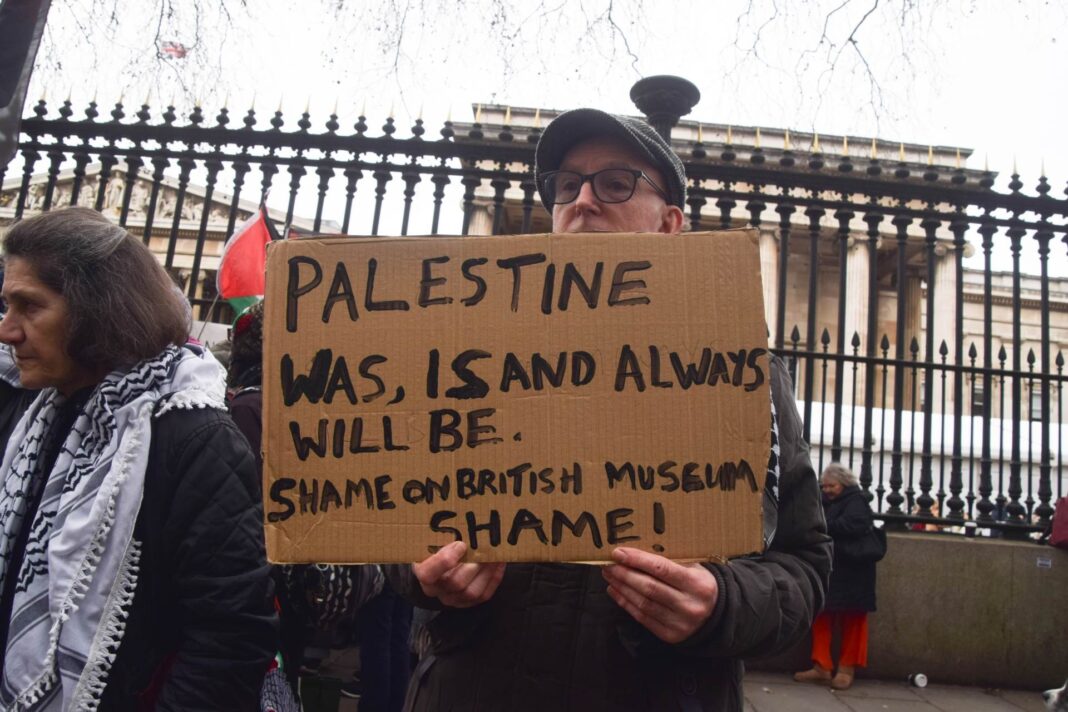
More than 200 cultural figures, including musician Brian Eno, signed an open letter in March 2026 urging the museum to “stop erasing Palestine,” according to Novara Media. Peter Leary, deputy director of the Palestine Solidarity Campaign, called MEE’s findings “chilling evidence” that pro-Israel groups had been simultaneously working “to eliminate all mention of Palestine’s past,” adding that the campaign “seems to have unfolded against the backdrop of Israel’s genocide in Gaza, including the deliberate destruction of historic sites, universities and cultural institutions alongside homes, schools, hospitals.”
The museum’s handling of Israel-related events has separately generated internal staff protests. Staff wrote multiple letters of complaint after the museum hosted an Israeli embassy event in May 2025 to mark Israel’s independence day, attended by then-ambassador Tzipi Hotovely, Reform UK leader Nigel Farage and Conservative leader Kemi Badenoch. Staff told MEE they received “absolute non-responses” from management to their concerns. A fundraising “Pink Ball” the same year drew protests that led celebrities including Idris Elba and Zadie Smith to withdraw, after activists highlighted the presence of companies with alleged links to what campaigners describe as Israel’s genocide in Gaza.
Background
The British Museum is publicly funded but governed by an independent board of trustees, currently chaired by Osborne. Nick Cullinan became its director in 2024. The disputed gallery texts include panels installed between 1998 and 2008, meaning the changes involved decades-old descriptions of ancient history rather than contemporary political terminology. Changes implemented include the removal of “Palestinian” from a description of the Hyksos, alterations to the Phoenicians panel in Room 57, edits to the Ancient Levant room at its entrance, and the removal of the phrase “Israelites occupied most of Palestine.” The Ancient Levant display covers the period 7,500 to 332 BCE. UK Lawyers for Israel is a pro-Israel campaigning organisation whose public intervention in February 2026 initially brought the removals to wider public attention.
What happens next
The Palestinian ambassador has said he will continue engaging with the museum and the British government until the original labels are restored. Palestine Solidarity Campaign has called on the museum to return items it describes as looted from Palestine, in addition to reversing the label changes. The Board of Deputies, which co-hosted a British Museum lecture in June 2026 as part of Jewish Culture Month, did not respond to MEE’s request for comment. No parliamentary debate or formal government inquiry into the matter had been announced at the time of publication.