
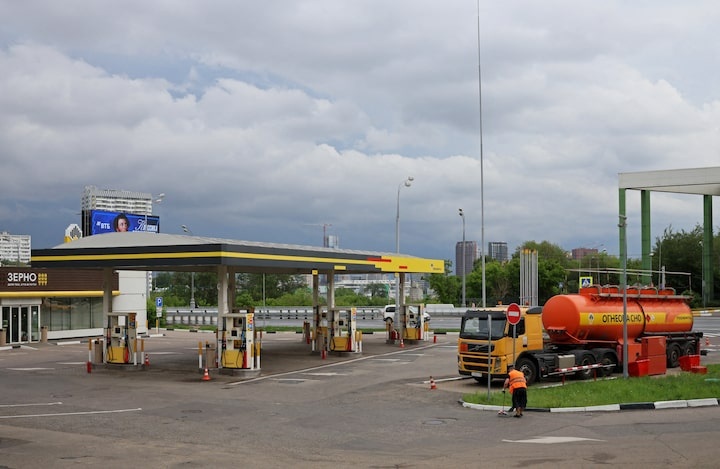

Russian President Vladimir Putin made a rare public concession on Sunday, June 29, acknowledging that Ukrainian drone strikes on energy infrastructure had produced fuel shortages severe enough to disrupt daily life across the country. “You are well aware that problems for drivers and for businesses persist,” Putin said in unusually candid remarks to a meeting of senior officials, according to Russian news agencies. “Unfortunately, there are still queues at petrol stations too.” The admission came as at least 55 of Russia’s 83 federal entities reported either mandatory government restrictions on petrol and diesel sales, or restrictions imposed by private companies operating fuel stations, according to an RFE/RL tally as of June 24.
Some motorists have waited up to 13 hours at petrol stations, and confrontations between drivers have broken out at filling stations as Russians compete for limited supplies. In Sverdlovsk Oblast, police were called after a dispute at a petrol station turned violent. Separate incidents were also reported in Ryazan and Irkutsk.
Compared to June 2025, Russian petrol production has dropped roughly 25%, driven by a renewed Ukrainian campaign of drone attacks on oil refineries, ports and pipelines throughout 2026. Christopher Weafer, chief executive of Macro-Advisory, estimated that around one-third of Russia’s refining capacity has been knocked out, based on fragmented information and industry sources, noting that the Russian state does not make the relevant data public.
Russia’s Norsi refinery, the country’s fourth-largest oil facility and second-largest producer of petrol, suspended operations last week after a Ukrainian drone attack. The facility is near Kstovo in the Nizhny Novgorod region, 450 kilometres east of Moscow. Ukraine also struck Russia’s Orenburg gas processing plant in the southern Urals, which has a capacity of 45 billion cubic metres of natural gas per year. The largest fuel supplier to the Moscow region, the Kapotnya refinery, was hit twice in June and will be offline until at least the end of 2026, unnamed officials told Reuters.
The crisis is not confined to the capital. Queues at petrol stations are growing, with long lines of cars stretching for hours, and social media is replete with videos of drivers expressing shock at the queues they encounter or arguing over empty pumps. “Television says one thing, reality is another. People are queuing everywhere,” said a Moscow resident identified as Andrei. Another Moscow resident, Maxim, said he was spending hours in line. “A country that produces oil, yet there is no petrol.”
Officials in Moscow have blamed the shortages on panic buying and urged motorists to fill up only when necessary. Exports of petrol and aviation fuel were curtailed, and a ban on diesel exports was also under consideration. A total ban on gasoline exports remains in force through July 31 to prevent shortages and rising prices, and Russia’s Energy Ministry has said supply in the domestic market remains “stable and under control.”
Igor Overland, a researcher at the Norwegian Institute of International Affairs, rejected that framing. “The majority of Russia’s regions have introduced limits on the sale of petrol and diesel, and some gas stations have shut down or have queues that can take up to 12 hours to get through,” Overland said. “This, in turn, disrupts the movement of people getting to work, transportation of goods, taxis and agriculture.”
Russia petitioned Kazakhstan on June 24 to provide 50,000 metric tons of AI-92 petrol to alleviate domestic shortages. That request followed a wave of fuel smuggling in the reverse direction: Kazakh authorities reported apprehending more than 700 illicit initiatives to smuggle fuel-related products out of Kazakhstan abroad, with one gang reportedly managing to move over $75 million worth of AI-92 petrol to a Central Asian neighbour.
Regional and global impact
Fuel shortages in Russia — the world’s largest wheat exporter — are expected to disrupt the critical July-August harvest season, when fuel is needed to run tractors, water pumps and other farm machinery, as well as to transport produce. Weafer said the petrol crisis “comes at a critical moment for the Russian economy, as the agricultural season and especially the harvest period is now gathering pace.”
Two-thirds of Russia’s 83 federal entities are experiencing fuel rationing, implemented either by government mandate or by private companies. Russia’s broader economy is struggling under the combined weight of military costs, labour shortages and sanctions, with growth stagnating at around 1% for 2025 and projected to remain near that level in 2026 despite inflation running between 5% and 9%. The Kremlin’s budget deficit doubled over the past year, and Moscow has raised tax burdens on its population while Putin has reportedly solicited oligarchs for donations to the federal budget.
Margarita Zavadskaya, a political scientist who studies Russian domestic politics, said the crisis is unlikely to trigger sudden regime collapse but poses a longer-term political threat. “The impact is mostly attritional, cumulative and politically corrosive rather than immediately destabilising,” she said.
Background
A sustained increase in Ukrainian targeted attacks on Russian energy infrastructure began in the second half of 2025, with Ukraine carrying out over a dozen drone attacks on Russian oil infrastructure between August 2 and 24 alone, the majority striking facilities in Ryazan Oblast and Volgograd Oblast. In December 2025, energy analyst Craig Kennedy described the situation as the worst crisis in Russia’s energy sector since the 1990s, warning that new US, EU and UK sanctions would further erode Moscow’s oil revenues in 2026. Analysts at The Moscow Times noted that Russia had experienced localised petrol crises in 2011, 2018 and 2021, each time with similar mechanics — shortages of specific fuel grades in individual regions during the summer vacation season — but that the current crisis is broader and longer in duration than any of those predecessors.
What happens next
The Kremlin has said it plans to draw on fuel reserves and increase domestic deliveries while repairing damaged infrastructure, while Ukrainian officials have indicated they intend to continue targeting facilities that support Russia’s military operations. The Kremlin’s options for addressing the crisis include continuing to lower fuel quality standards, increasing imports of petroleum products from Belarus, and the politically painful step of reforming fuel price subsidies, though analysts said these measures are unlikely to fully offset the decline in refining capacity if the war continues. Ukraine also struck two oil facilities in Kerch in Crimea and the port of Kavkaz in late June, as well as the Slavyansk and Yaroslavl oil refineries, signalling that the campaign against Russian energy infrastructure is widening rather than contracting.