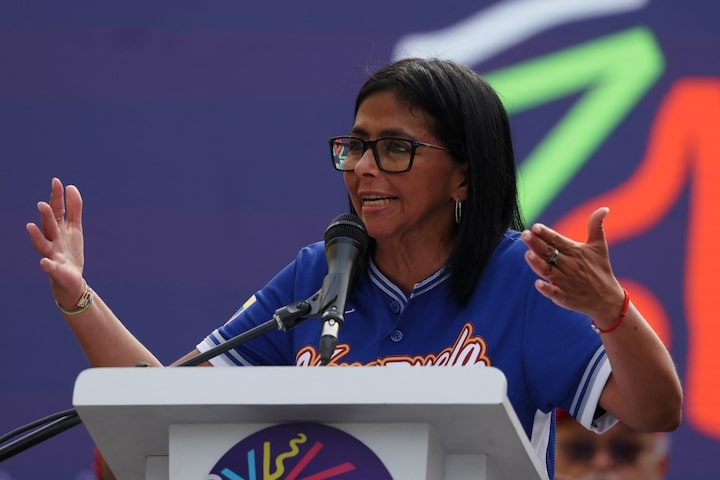

Venezuela’s Acting President Delcy Rodríguez arrived in the Netherlands on Sunday, May 10, to personally represent her country at the International Court of Justice during the final round of oral hearings in the oil-rich Essequibo territorial dispute with Guyana. The trip is her first outside the Caribbean since U.S. forces captured former President Nicolás Maduro in January and flew him to the United States to face trial. The ICJ hearings, which opened on May 4 at the Peace Palace in The Hague, are scheduled to conclude on Monday, May 11.
Rodríguez Speaks Before Departure
“It has fallen to me to travel in the coming hours to defend our homeland,” Rodríguez said in a televised speech before departing Caracas. Her announcement on Saturday that she would lead the Venezuelan delegation came as a surprise, given her absence from international travel since assuming power in January.
Rodríguez was Maduro’s vice president when he was captured and flown to the United States to stand trial. She had long been under U.S. sanctions, which were lifted when she became acting president. Officials attending ICJ proceedings are typically granted special legal protections regardless of their sanctions status, according to Al Jazeera.
What Is at Stake
The Essequibo region at the centre of the case is one of the most resource-rich territorial disputes in the Western Hemisphere. The sprawling region bordering eastern Venezuela accounts for two-thirds of Guyana’s current territory. The discovery by ExxonMobil of offshore oil deposits in Essequibo gave Guyana — with a population of less than a million — the largest per capita crude oil reserves in the world.
Guyana currently produces approximately 750,000 barrels of oil per day, largely from reserves in and around the Essequibo region, making the court’s eventual ruling one of the highest-stakes territorial decisions in recent ICJ history.
Venezuela’s Legal Position
Venezuela’s arguments at the ICJ have centred on rejecting the court’s authority altogether. Venezuela’s agent Samuel Moncada rejected the court’s jurisdiction over the Essequibo dispute on May 6, arguing that Caracas “never consented” to submit territorial questions to international courts. He invoked the 1966 Geneva Agreement as the only binding framework and described the country’s historical rights as “irrenunciables” — inalienable — during a six-hour presentation before a panel of 15 ICJ judges.
Moncada accused Guyana of “deliberately misleading” the court, according to Rio Times, and wore a lapel pin depicting a Venezuelan map that included the disputed territory.
Venezuela argues that the border should be drawn in accordance with the 1966 Geneva Agreement, signed before Guyana gained its independence, and that the Essequibo River — located much farther east than the current border — is the natural frontier, as it was under Spanish colonial rule in 1777.
Guyana’s Position
Guyana brought the dispute before the ICJ in March 2018, asking the court to declare that Venezuela has no legitimate claim to the Essequibo territory and that the Arbitral Award of October 3, 1899, which established the boundary between what was then British Guiana and Venezuela, remains valid under international law.
Guyana’s Ministry of Foreign Affairs said the country approaches the hearings with full confidence in the strength of its case. The government has received support from CARICOM, the Commonwealth, the European Union, and the Organization of American States.
Venezuela’s Prior Defiance of the Court
Venezuela’s participation in the hearings does not represent a change in its fundamental legal stance. Venezuela’s Acting President Delcy Rodríguez stated in August 2025 that Venezuela would ignore the ICJ’s final ruling. The country has taken a series of unilateral steps to assert control. In December 2023, the Venezuelan government held a consultative referendum in which voters endorsed the creation of a “Guayana Esequiba” state. In April 2024, former President Nicolás Maduro promulgated an “Organic Law in Defense of Guayana Esequiba,” purporting to formally incorporate the Essequibo into Venezuelan territory and establish administrative units for oil and mineral exploitation.
Regional Tensions
The hearings have already generated diplomatic friction. Tensions mounted in the weeks leading up to the hearings when Guyana’s President Irfaan Ali wrote to Caribbean Community (CARICOM) chairman Terrance Drew, protesting a brooch worn by Rodríguez during visits to Grenada and Barbados that depicted a map of Venezuela including the Essequibo.
Despite saying she was invited to the United States by the Trump administration, Rodríguez has so far not made that trip. Her decision to travel to The Hague instead for the Essequibo hearing carries domestic political significance. In April, Rodríguez’s 90-day term as interim leader expired and parliament had not publicly extended it.
Background
The Essequibo dispute traces its roots to the 19th century, when Venezuela and British Guiana contested the western boundary of the colony. An international arbitration tribunal established the border through the 1899 Arbitral Award. Venezuela repudiated that ruling in 1962 and has pressed its claim ever since. Guyana brought the dispute to the ICJ in 2018. The disputed territory covers 160,000 square kilometres, roughly two-thirds of Guyana’s total landmass. ICJ rulings are binding and without appeal, but the court has no enforcement mechanism of its own and instead relies on the UN Security Council, according to Reuters. Rodríguez, a supporter of Maduro’s Chavismo movement, has remained compliant with a list of U.S. demands since assuming power, including stopping oil deliveries to Cuba, opening Venezuela’s state-owned oil industry to foreign companies, and releasing political prisoners.
What Happens Next
Venezuela’s second and final round of oral arguments is scheduled for Monday, May 11, after which the court will adjourn. A final ruling is expected months away, with August 2026 the earliest informal projection cited by observers. Rulings are binding and without appeal, but the court has no way to enforce them itself, instead relying on the UN Security Council, Reuters reported. Venezuela has already stated it would not comply with a ruling against it. Guyana is expected to continue administering the Essequibo region and its oil operations under ExxonMobil during the period before any judgment is issued.