
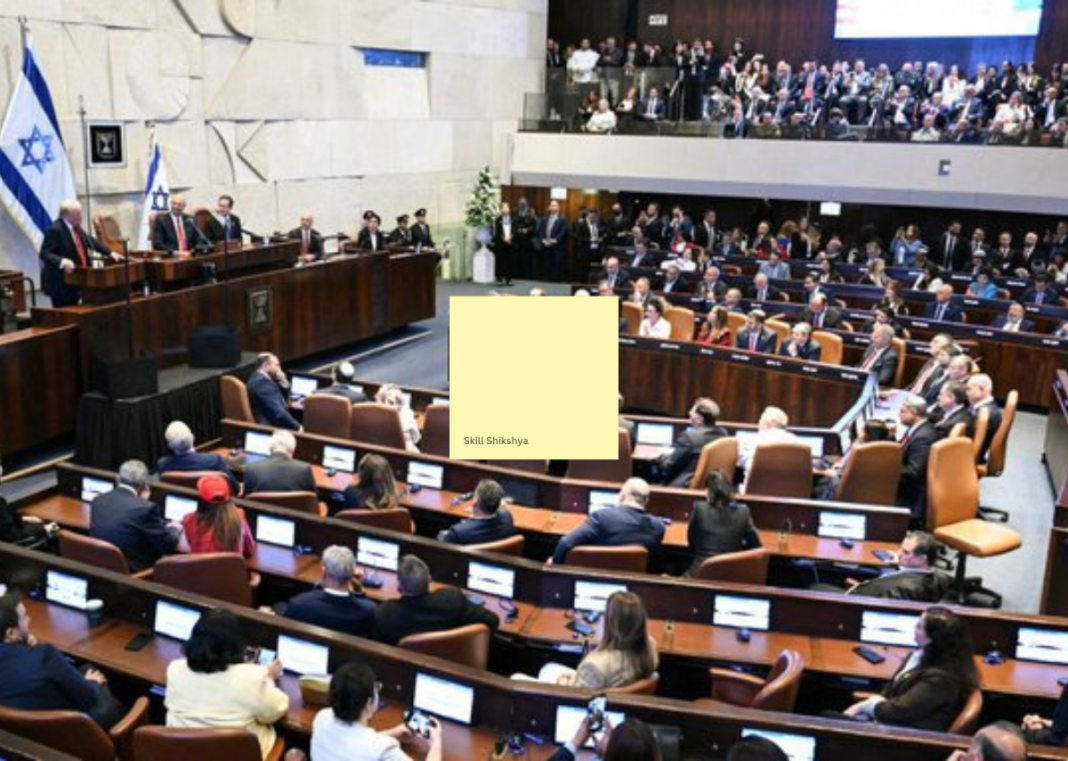

Israeli Knesset Advances Dissolution Bill as Ultra-Orthodox Rift Forces Early Election Push
Israel’s parliament passed the first reading of a bill to dissolve itself on Monday, setting the country on a path to elections as early as September after the spiritual leader of a key ultra-Orthodox coalition partner ordered his party’s lawmakers to trigger the vote over an unresolved military draft dispute. The bill passed its first reading late on Monday, with 106 lawmakers voting in favour and no objections recorded. Two further Knesset readings are required before dissolution takes legal effect. Washington Times
According to Haaretz, the law’s final approval would open the possibility of elections between 8 September and 20 October, moving the vote forward from the previously scheduled date of 27 October. Washington Times
The vote was triggered after Dov Lando, the spiritual leader of Degel HaTorah — one of the two ultra-Orthodox parties composing the United Torah Judaism alliance — ordered his party’s members to dissolve the Knesset. Lando’s directive came after the coalition failed to pass a comprehensive law exempting ultra-Orthodox men from military conscription, a commitment that has remained unfulfilled since the government took power in late 2022. Washington Times
The issue of ultra-Orthodox enlistment has become a central flashpoint in Israel since the beginning of its military campaign in Gaza. Since Israel’s independence in 1948, ultra-Orthodox men have largely been exempt from army service. But with Israel fighting simultaneous wars in Gaza, Iran and Lebanon, army officials have warned that a continued exemption for ultra-Orthodox men would damage the military’s operational capacity. Washington Times
The two ultra-Orthodox coalition partners are pushing for different election dates. The United Torah Judaism party is aiming for elections on 1 September, while Shas, the other ultra-Orthodox ally of Prime Minister Benjamin Netanyahu, has asked that the vote be held on 15 September. Washington Times
The electoral timetable carries its own institutional complications. Israel’s Central Elections Committee warned that elections on 15 September, a period that falls during successive Jewish holidays, would lead to a one-day delay in vote counting and the publishing of official results. Washington Times
The elections committee itself has become a source of political controversy. The committee’s former longtime director, Orly Adas, resigned in May, stating her resignation was intended to prevent the undermining of the committee. That resignation preceded a warning issued on Monday by Yitzhak Amit, President of Israel’s Supreme Court. Amit cautioned against attempts to undermine the election results, saying “if anything can be faked, why believe anything at all?” He added that the phenomenon of falsification poses “a threat to the very existence of the electoral process and to the functioning of the democratic system.” Washington TimesWashington Times
Netanyahu enters any election campaign in a structurally weak position. A Ma’ariv poll published on Friday suggested his current coalition could win up to 52 Knesset seats — well short of the 61 required to form a government. Washington Times
Netanyahu’s response to that deficit has drawn accusations of democratic manipulation. Channel 13 News reported last week that Netanyahu is considering banning the United Arab List, known as Ra’am, from the elections by having it designated as a terrorist group. The move is seen as a way to prevent any of Netanyahu’s opponents from forming a governing coalition, as Ra’am and other Palestinian parties in Israel could determine who becomes Israel’s next prime minister if they win several Knesset seats. Washington Times
The opposition is consolidating ahead of the anticipated vote. Former Israeli Prime Ministers Naftali Bennett and Yair Lapid have merged their parties ahead of the elections, according to Middle East Eye reporting, creating a combined bloc designed to maximise seats against Netanyahu’s Likud-led coalition. Washington Times
Regional and Global Impact
An Israeli election called while the country is simultaneously fighting wars in Gaza, Lebanon and Iran, and while ceasefire negotiations with the United States remain unresolved, introduces a level of political uncertainty without recent precedent in Israeli history. A change of government in September or October could alter Israel’s negotiating posture on the Iran nuclear question and on the terms of any Hormuz settlement that involves Israeli interests. For the United States, a Netanyahu defeat would remove the principal Israeli counterpart with whom the current ceasefire architecture was negotiated. For Palestinians in Gaza, a new Israeli government formed without the far-right blocs currently providing Netanyahu his parliamentary base would carry different implications for any postwar political process — though no opposition party has publicly committed to a ceasefire or withdrawal timetable.
Background
Israel’s Basic Law: The Knesset sets the parliament’s term at four years, with early dissolution requiring the passage of a dissolution bill through multiple readings. The current government, formed in late 2022, has been the most right-wing in Israeli history and has depended on ultra-Orthodox parties — Shas and United Torah Judaism — as essential coalition partners. The failure to legislate a comprehensive ultra-Orthodox draft exemption has been a recurring source of coalition tension, particularly as military casualties in multiple active theatres have intensified public debate about the fairness of the conscription burden. Netanyahu is currently subject to an ongoing criminal trial on corruption charges, which continues regardless of the electoral calendar.
What Happens Next
The dissolution bill must pass two further Knesset readings before it takes legal effect. The date of those readings has not been publicly scheduled. Should the bill clear all three readings, an election between 8 September and 20 October becomes legally possible, with the two ultra-Orthodox parties preferring 1 September and 15 September respectively. The Central Elections Committee will be required to finalise a date and logistics once the bill passes. Netanyahu’s reported consideration of banning Ra’am from standing has not produced a formal government decision as of Monday. The Supreme Court President’s warnings about election integrity signal that any such move would face immediate legal challenge. Washington Times