
Turkish security forces arrested 225 people in Ankara this week after authorities imposed a 13-day ban on public assemblies ahead of a Nato summit scheduled for July 7-8. Amnesty International condemned both the ban and the arrests on Saturday, calling them an attack on the right to peaceful assembly. The crackdown began Sunday, June 21, when the Ankara Governorate announced the province-wide restriction, citing national security concerns tied to the conference.
Of the 225 people detained, 178 were formally arrested while 34 were released under judicial supervision, according to the state-run Anadolu news agency. Those held included alleged supporters of the Revolutionary People’s Liberation Party/Front, a leftist group known by the acronym DHKP/C, as well as alleged supporters of the Islamic State group.
The detainees also included figures with no apparent link to either movement. Academic Emel Memis, LGBTQ rights activist and journalist Yildiz Tar, and Tema Foundation environmental representative Nevzat Ozer were among those arrested, Middle East Eye reported. Independent labour union Umut-Sen spokesperson Burcu Arikan was also detained, along with Progressive Lawyers Association lawyers Semra Demir and Kursat Bafra.
Esther Major, Amnesty International’s deputy director of research for Europe, said the measures went beyond what security needs could justify. “All the excessively broad and disproportionate restrictions that prevent the exercise of the right to peaceful assembly must be lifted,” she said.
Major also criticized a separate decision by Nato to deny press credentials to several Turkish outlets covering the summit. “Nato’s decision to deny accreditation to some journalists and media outlets from Turkey is a blow to media freedom,” she said. “We call on Nato to reverse its stance and enable those who have been excluded to cover the event.”
Dozens of journalists were denied accreditation for the summit, including reporters from independent Turkish outlets Cumhuriyet, Sozcu, Anka, T24 and Medyascope. On Friday, June 26, a coalition of media freedom organizations issued a joint statement objecting to the decision.
The statement noted that Nato’s own accreditation rules list editorial independence as a core requirement, making the rejection of outlets known for that independence difficult to reconcile with the alliance’s stated criteria. It added that any involvement by a governmental institution with a record of restricting press access would risk letting domestic political pressure shape what is meant to be an independent credentialing process.
Middle East Eye said it had contacted Nato for comment but had not received a response by the time of publication.
Regional and Global Impact
The protest ban and arrests come as Turkey prepares to host leaders from all 32 Nato member states, including US President Donald Trump, who is expected to attend the Ankara summit. Amnesty International’s statement frames the restrictions as part of a broader pattern affecting assembly rights in Turkey during the lead-up to the conference. The press accreditation dispute has drawn separate criticism from media freedom groups, who argue it sets a precedent for political interference in Nato’s credentialing process.
Background
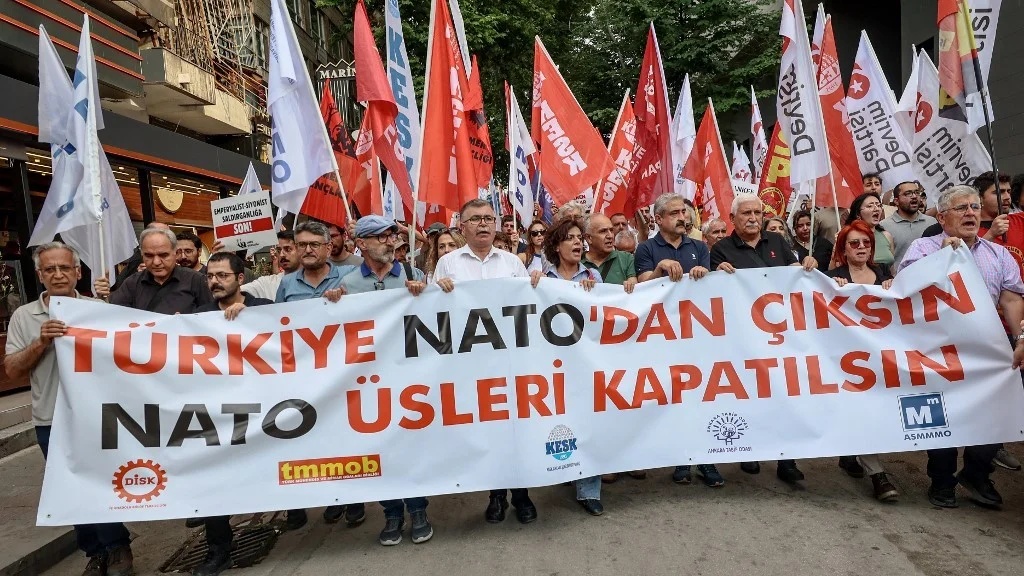
Turkey has been a Nato member since 1952 and maintains the alliance’s second-largest land army. Leftist groups and some Islamist movements in the country have long opposed Turkey’s Nato membership, arguing it entrenches US influence and has historically been used to suppress socialist and anti-imperialist movements domestically. Opposition to the summit has also been fueled by US backing for Israel’s military campaign in Gaza and US strikes on Iran, both of which have sharpened public anger toward the alliance inside Turkey. Protesters gathered in Ankara on June 27 carrying banners calling for Turkey to leave Nato and for Nato bases in the country to be closed.
What Happens Next
The Nato summit is set to proceed in Ankara on July 7-8 with leaders from all 32 member states expected to attend. The 13-day assembly ban announced by the Ankara Governorate remains in effect through the duration of the summit period. Media freedom organizations have called on Nato to reverse its accreditation decisions for the excluded Turkish outlets, though the alliance has not yet responded to that demand or to requests for comment from Middle East Eye.