
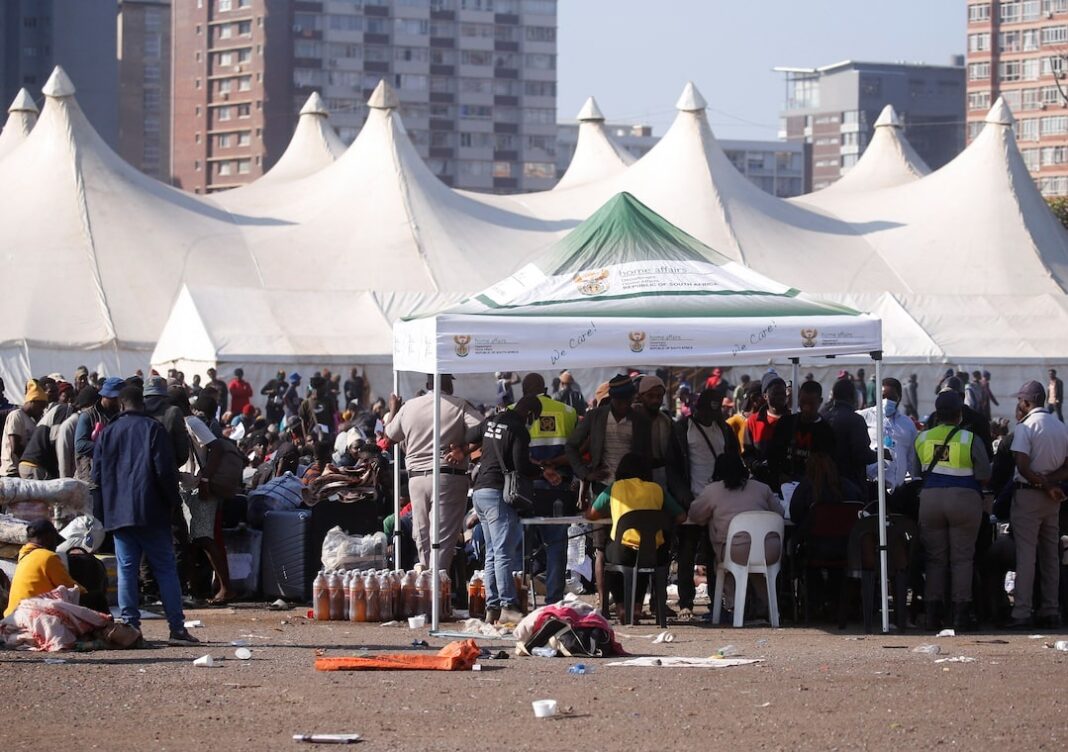

South African police announced extra deployments nationwide on Monday ahead of a June 30 deadline set by anti-migrant protest groups demanding that undocumented foreign nationals leave the country, according to Al Jazeera. The deadline, with no legal basis, follows months of protests and xenophobic violence that have killed at least two people. Defence Minister Angie Motshekga said the military will secure strategic sites including airports.
The unrest began in March 2026 and spread through Johannesburg, Pretoria, Durban and Cape Town before reaching towns in the Western Cape, according to a timeline compiled by Pindula. By mid-May, at least seven people had reportedly been killed since the protests started. Fresh violence in the coastal town of Mossel Bay in late May left several more dead and displaced hundreds of foreign nationals.
Two anti-immigration movements, March and March and Operation Dudula, have organized most of the demonstrations. March and March was founded in 2025 by Jacinta Ngobese-Zuma, while Operation Dudula was formerly led by Zandile Dabula, according to Pindula’s account of the protests.
The acting minister of police, Firoz Cachalia, said the South African Police Service is operationally prepared for demonstrations scheduled for June 30, according to Daily Maverick. He met with SAPS management, led by Acting National Commissioner Lieutenant General Puleng Dimpane, at the Tshwane Academy College in Pretoria on June 20 for briefings on national and provincial operational plans.
“Criminality, intimidation, violence, the destruction of property and any attempt to undermine public safety will not be tolerated,” Cachalia said, while also affirming the right to peaceful protest, Al Jazeera reported.
Human Rights Watch documented vigilante attacks on African and Asian foreign nationals, including shop owners beaten and assaulted with golf clubs and sjamboks, in a report released May 19. The rights group said police response to the attacks had been limited.
“South Africa’s constitution and international human rights law protect the right to protest, but that does not include permission to commit violence,” Nomathamsanqa Masiko-Mpaka, a Human Rights Watch South Africa researcher, told Al Jazeera.
Mike Ndlovu, media coordinator for Kopanang Africa Against Xenophobia, said his organization continues to receive reports of harassment and discrimination against migrants. “We continue to receive reports through our community networks of intimidation, threats, harassment, unlawful evictions, workplace discrimination, police extortion, and denial of access to healthcare and other basic services affecting migrants and refugees,” Ndlovu told Al Jazeera. He said verbal abuse, evictions and discrimination at clinics and workplaces were the most common forms of harm reported.
Regional impact
Several African governments have moved to repatriate citizens caught up in the unrest. Mozambique said five of its citizens were killed in xenophobic attacks and that roughly 800 Mozambicans had been affected, according to Pindula. About 300 Mozambican nationals returned home on May 31, with more than 500 others repatriated starting June 1. Ghana summoned South Africa’s ambassador and asked the African Union to add the attacks to the agenda of its upcoming summit, while organizing the evacuation of 300 Ghanaian citizens on May 21, fully funded by its government.
Nigeria’s foreign ministry said 1,094 Nigerians had registered interest in voluntary return after the attacks, according to ministry spokesperson Kimiebi Ebienfa, who spoke to Reuters. Ebienfa said joint screening by foreign ministry officials from both countries, along with South African immigration and police, concluded on June 13, with repatriation flights to be set once final numbers were confirmed. He said South African authorities had agreed to waive penalties for visa overstays, though individuals facing criminal charges would not be eligible to leave.
In the Western Cape, Overstrand municipal manager Dean O’Neill said three buses left the Kleinmond Town Hall on June 5 carrying undocumented foreign nationals to the Lindela Repatriation Centre, with two more buses departing from Gansbaai for the same facility. O’Neill said 38 people displaced by the protests were living on a municipal farm in Hermanus, and that a bus sent by the Mozambican Embassy had collected citizens wishing to leave.
Background
South Africa has a long history of anti-foreigner violence, fueled by allegations that migrants take jobs and drive crime, according to Al Jazeera. The country’s unemployment rate stands above 30 percent. Data published by Daily Maverick shows migrants account for fewer than four million of South Africa’s 63 million residents. Political parties including the Patriotic Alliance, ActionSA and uMkhonto we Sizwe have increasingly framed migrants as competitors for jobs and public services, according to Al Jazeera. President Cyril Ramaphosa addressed the nation on June 7, announcing immigration enforcement measures while condemning vigilante violence.
What happens next
Demonstrations are scheduled for June 30, the date set by protest organizers for undocumented migrants to leave the country. SAPS has confirmed it will deploy additional officers nationwide, while the military will secure airports and other strategic sites under Motshekga’s order, according to Al Jazeera. Nigeria and South African authorities are finalizing repatriation flight numbers following the completed screening process. Ramaphosa’s government has said it will continue implementing the immigration enforcement package announced on June 7.