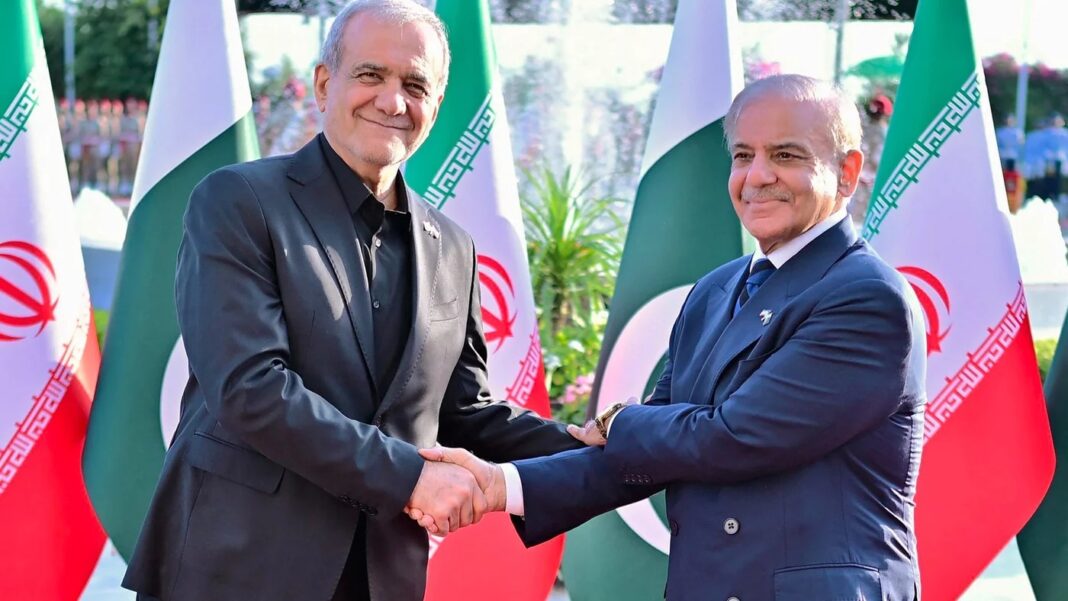

Pakistan’s Prime Minister Shehbaz Sharif said on Tuesday, June 23, that Iran’s ballistic missile programme was never discussed during negotiations between the United States and Iran, contradicting one of Washington’s original stated war aims. Sharif made the comments during Iranian President Masoud Pezeshkian’s visit to Islamabad, referring to the Islamabad Memorandum of Understanding signed between the two countries. The remarks came as Pakistan continues to mediate talks between Washington and Tehran following the US-Israel military campaign against Iran earlier this year.
“This MOU does not mention ballistic missiles. It was never on the table, it was never on the agenda and the Iranian side never even wanted to discuss it. This is not an impression, but a fact of the matter,” Sharif said. He added that Iran should not face restrictions that other states with missile arsenals do not face. “So I want to make it abundantly clear that, of course, there cannot be double standards; that some countries can have ballistic missiles and Iran shouldn’t have them. You cannot digest this kind of duplicity,” he said.
Pezeshkian went further than Sharif, stating that Iran’s missile programme would never be subject to negotiation under any circumstances. He said Iran would “never compromise on our missile programme and capabilities and this shall never be part of any agreement between Iran and any other party.” Pezeshkian also linked the missile programme directly to Iran’s survival during the conflict with Israel and the United States. “If the missiles we have for our defence did not exist, Israel and the United States would have ploughed Iran just like Gaza, showing no mercy to either the old or the young,” he said.
The comments stand in contrast to the stated US position when military operations against Iran began. A White House memo dated April 1 stated that the war’s objectives included obliterating “Iran’s ballistic missile arsenal and production capability” and eliminating “the threat of Iran’s short-range ballistic missiles.”
US President Donald Trump has since acknowledged that demanding Iran dismantle its missile programme was not realistic. Speaking at the G7 summit in Paris last week, Trump said, “I’m saying that if other countries have them, it’s a little bit unfair for them not to have some.”
According to Middle East Eye, the shift reflects a broader pattern. The publication reported that the majority of the war’s original objectives, including regime change, the destruction of Iran’s ballistic missile programme, the destruction of its navy and the seizure of its uranium stockpiles, had not been achieved by the time hostilities ended.
Diplomatic engagement between Washington and Tehran has continued under the framework established by the Islamabad MOU. The two countries held talks in Switzerland, which brought hostilities to a halt for a 60-day period to allow for technical negotiations. On Monday, the US suspended sanctions against Iran after the two sides disagreed over nuclear and weapons inspections during talks that US Vice President JD Vance described as “good progress.”
Sharif called the Monday session a success and announced that the talks had produced a roadmap toward a final deal within 60 days. Pakistan and Qatar are mediating the negotiations, with Vance leading discussions on the US side and Mohammad Bagher Ghalibaf serving as Iran’s chief negotiator. On Tuesday, Trump said the US was working toward a fair deal with Iran and that the two countries were getting along well.
Regional and Global Impact
The US has prioritised reopening the Strait of Hormuz, which was freely navigable before the US launched its war, and preventing Iran from acquiring a nuclear weapon as its two main objectives in the negotiations. The suspension of sanctions is expected to benefit Iran’s oil sector, which produced roughly 4.6 million barrels of oil per day and exported around 1.5 million barrels per day before the US imposed its own blockade in response to Iran’s closure of the Strait of Hormuz.
The Lebanon front remains separate from the US-Iran track and has proven harder to resolve. The Islamabad MOU commits to ending hostilities in Lebanon, but Israel has openly resisted US efforts to end that conflict, with parallel negotiations between Israel and Lebanon proceeding independently of the US-Iran talks. Lebanon and Israel began a fifth round of direct negotiations in Washington on Tuesday, with Beirut seeking to revive proposals for an Israeli withdrawal from southern Lebanon, after four previous rounds failed to produce a lasting ceasefire.
Background
The US and Israel launched a military campaign against Iran earlier this year, citing Iran’s ballistic missile arsenal, its navy and its uranium stockpiles among the operation’s targets. Hostilities were halted under the Islamabad Memorandum of Understanding, which established a 60-day window for technical negotiations between Washington and Tehran. Pakistan and Qatar have served as mediators throughout the process. Talks have since taken place in Switzerland near Lake Lucerne, producing a separate mechanism aimed at easing tensions between Israel and Hezbollah. The Lebanon dimension of the ceasefire framework has lagged behind the US-Iran track, with Israel maintaining conditions tied to Hezbollah’s disarmament.
What Happens Next
Sharif said the roadmap agreed on Monday targets a final deal within 60 days. Lebanon and Israel are continuing a three-day round of negotiations in Washington that began Tuesday, with Lebanon pressing for a withdrawal timetable, the return of displaced people, the release of prisoners and the start of reconstruction. Israel has tied any withdrawal to Hezbollah’s disarmament and has said its forces will retain control of a security zone in southern Lebanon until it is satisfied the Lebanese army can prevent the group from rebuilding militarily. Further rounds of US-Iran technical talks are expected to continue under the Islamabad MOU framework before the 60-day deadline.