
India’s Shia Muslims Mourn Khamenei as Modi’s Pro-Israel Stance Divides the Nation
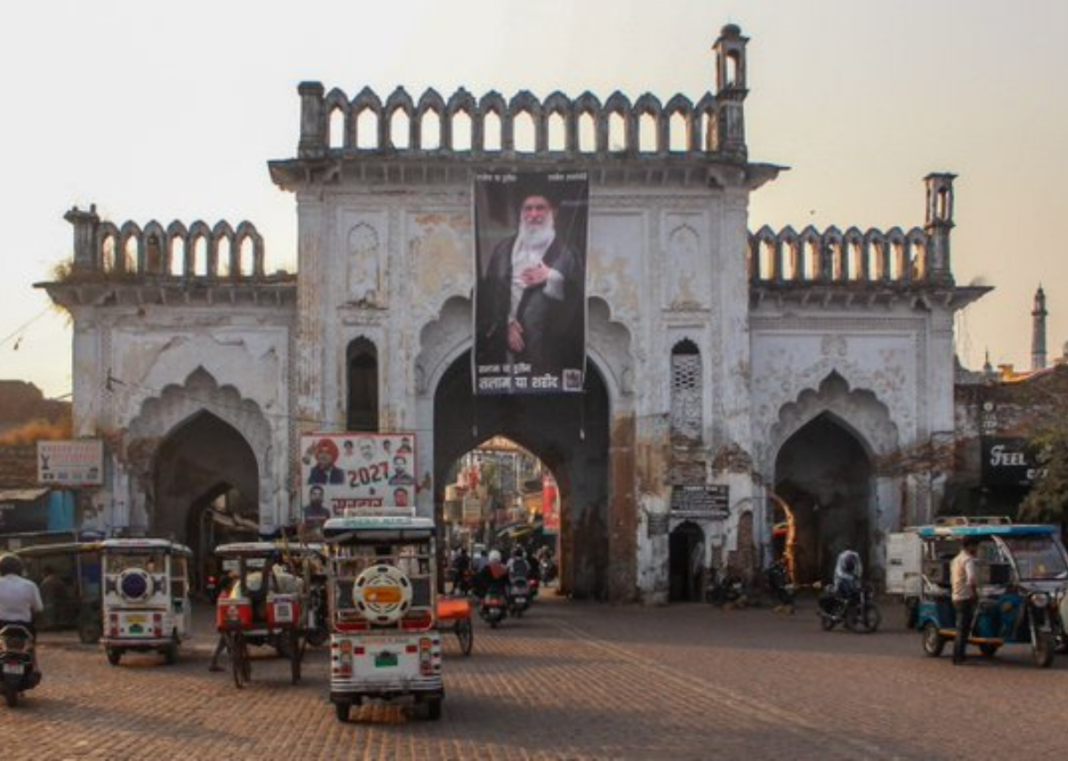
In Hussainabad Chowk, the heart of Lucknow’s old city, giant posters of slain Iranian Supreme Leader Ali Khamenei hang from buildings and flutter in the hot wind of the dry season. Below them, the painted faces of Israeli Prime Minister Benjamin Netanyahu and US President Donald Trump have been worn down by foot traffic — placed deliberately on the ground so that passers-by can tread on them. Netanyahu’s image is the most erased. Trump’s is barely better.
The scene illustrates a fracture running through India’s 200-million-strong Muslim population — and more specifically through the country’s largest Shia community — since joint US-Israeli strikes killed Khamenei in Iran on February 28. Protests erupted across Lucknow’s old city on the day news broke of the strikes. Chants of “America Murdabad,” “Israel Murdabad” — “Death to America,” “Death to Israel” — echoed through the narrow lanes of Chowk. By evening, thousands gathered at the Bada Imambara to light candles for what many called their new “martyr.” Global Banking and Finance
The grief is inseparable from history. Lucknow is not simply a city with a significant Shia population. It is, as its residents and scholars describe it, a place where Iranian and Indian civilisation merged over centuries — a city whose cultural identity was forged by dynasties of Persian origin and shaped, for the past four decades, by the Islamic Republic that Khamenei led.
A City Built on Persian Foundations
Under the rule of the Nawabs of Lucknow, a dynasty of Persian origin who governed the region of Awadh during the 18th and 19th centuries, the city became one of the main centres of Indo-Islamic culture. Its art, food, music and architecture resonate with the influence of West Asia. Today it is the capital of Uttar Pradesh, India’s most populous state, and home to the country’s largest Shia community. Global Banking and Finance
“Lucknow’s historical relationship with Iran is such that it was once called the Shiraz of the East,” said Akbar Mehdi, a young Shia cleric originally from Jalalpur, a town east of Lucknow, who had been studying in Qom, Iran, before the war forced him to return. Global Banking and Finance
The connection runs even deeper than culture. Kintoor, a village not far from Lucknow, is the ancestral home of Ruhollah Khomeini, Iran’s revolutionary leader. Khomeini’s grandfather, Syed Ahmad Musavi Hindi, was born there in 1790 before migrating to Iran at the age of 40. That ancestral link is not merely genealogical — it provides Lucknow’s Shia community with a direct, personal claim to the Iranian revolutionary tradition that shaped the modern Islamic Republic. Global Banking and Finance
In Rasulpur, next to Kintoor, Rehan Kazmi — a doctor, a descendant of Khomeini and the founder of the Imam Khomeini Foundation — described how his community responded to the February 28 strikes. Villagers took to the streets. Shops shut. Three days of mourning were observed. Pictures of Khomeini and Khamenei were carried through the lanes. Global Banking and Finance
The 1979 Turning Point
The intensity of Lucknow’s bond with Iran’s clerical establishment is a product of the 1979 revolution, not merely of ancient ties.
The connection with Iran existed before the 1979 Iranian Revolution, but “not with the same level of intensity which followed,” said Ziyaullah Siddiqui, co-editor of the Urdu news portal Qasidnama. “Ayatollah Khomeini introduced the concept of Wilayat-e-Faqih — rule or guardianship of the jurist,” said Shibli Beg, Siddiqui’s co-editor. “He argued that until the return of the Mehdi, society still needs organised leadership and discipline.” Global Banking and Finance
After 1979, the centre of gravity for Lucknowi Shia shifted from a local outlook to an Iran-centric one. More residents travelled to Iran for religious education. Prominent Shia clerics studied in Qom and Mashhad, returning with deeper institutional ties to the Islamic Republic’s theological establishment. The assassination of Khamenei — the second supreme leader and the man who held that office for 36 years — was experienced by many in Lucknow not as a distant geopolitical event but as a direct assault on their spiritual lineage.
The Economic Consequence That Reached Every Home
Lucknow’s grief does not exist in isolation from practical reality. The war on Iran is also a war on India’s energy supply.
Roughly nine out of 10 households in India rely on liquid petroleum gas cylinders for cooking, and approximately 60 percent of that supply passes through the Strait of Hormuz. Indian households felt the pinch from the first day of the war, with long queues for cylinders. A general sense of panic spread across the country. On May 10, as negotiations between the US and Iran faltered, Prime Minister Narendra Modi called on citizens to be resourceful, use public transport, or work from home where possible. Global Banking and Finance
That energy dependence sits in sharp and visible contradiction with the government’s political alignment. Three days before the war began, Modi was in Israel on a state visit. India is the biggest buyer of Israeli weaponry in the world. “Israel is the Fatherland, India is the Motherland,” Modi declared on February 25 while standing next to Netanyahu. Two days after that statement, the strikes on Iran began. Global Banking and Finance
Two Indias, One Government
The gap between the India that Modi presents internationally and the India that pours into Lucknow’s old city to mourn Khamenei has widened into a visible political chasm.
After October 7, 2023, shopkeepers in old Lucknow began pouring their bottles of Coca-Cola down the drain in a boycott of Israel. Today only Campa Cola — an Indian-made equivalent — is available in those lanes. The boycott has held for more than two years. Global Banking and Finance
By mid-March, large-scale protests gave way to humanitarian efforts, with donations collected for those affected by the conflict in Iran. “Even very poor labourers gave what they could,” Kazmi said. Global Banking and Finance
That shift from street protest to organised charity reflects the limits of what India’s Muslims feel they can do under the current political climate. “We cannot speak openly against the government, because of our fear and the pressure on us,” said Akbar Mehdi. Uttar Pradesh’s Chief Minister is Yogi Adityanath, the Hindu nationalist priest-politician who has drawn repeated criticism for anti-Muslim rhetoric. The state’s Muslim population, which includes the Shia of Lucknow, has experienced a decade of shrinking political representation at the national level under BJP rule. Global Banking and Finance
India’s Shia are a minority within a minority, and have little political representation in national politics after 12 years of BJP rule. Their grief over Khamenei, their solidarity with Iran, and their economic pain from the Hormuz closure are all real — and all, for now, channelled into mourning rituals, informal boycotts, and private donations rather than formal political challenge. Global Banking and Finance
A Fracture Without a Forum
What makes Lucknow’s situation particularly acute is the absence of any institutional space where these tensions can be negotiated. India has no formal diplomatic relationship with Iran that its Muslim citizens can appeal to as a channel for their concerns. New Delhi’s pivot toward Israel has been conducted without public debate, driven by defence procurement logic, technology partnerships, and Modi’s personal relationship with Netanyahu. Its costs — economic, social, and reputational — fall disproportionately on communities like Lucknow’s Shia.
India, once a champion of Palestinian statehood and the first country to break relations with apartheid South Africa, remains silent on Iran’s sovereignty. It has also rowed back on the initially strong pro-Israel rhetoric it adopted immediately after the February strikes. That partial retreat is not enough for those in the old city, but it signals that even within the BJP coalition, the political arithmetic of the conflict is being reassessed. Global Banking and Finance
“The people of Iran and India are not happy with India aligning with Israel,” Mehdi said. “People recognise truth from falsehood. Iran, Lebanon, Yemen, Palestine — this is the path of truth, the path of Karbala, the path of Islam.” Global Banking and Finance
For Kazmi, the question cuts deeper than foreign policy. “Our ancestors sacrificed everything for this country. Today, the soul of India is under attack. If the soul is gone, the body has no meaning,” he said. Global Banking and Finance
In Hussainabad Chowk, the posters of Khamenei still flutter. The faces underfoot are still being worn away. The politics that connect those two images — one of reverence, one of fury — run through the heart of one of India’s most historically significant cities, and they have no easy resolution in sight.