
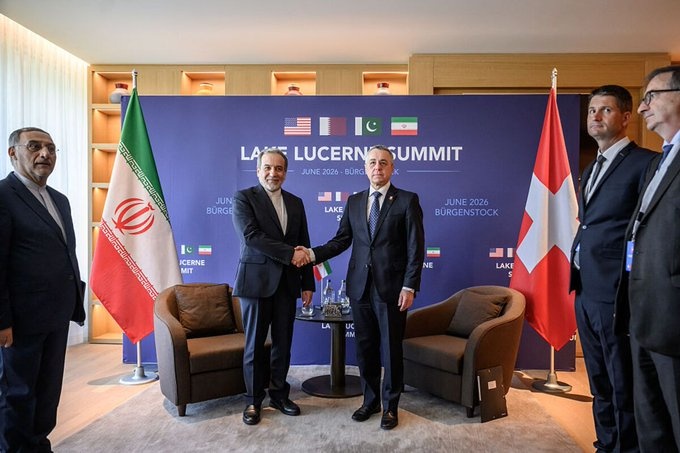

U.S. Vice President JD Vance and senior Iranian negotiators arrived Sunday at the Bürgenstock resort near Lucerne, Switzerland, to formally launch talks on Tehran’s nuclear program. The session was originally scheduled for Friday but was delayed two days after fighting escalated in Lebanon, according to the Associated Press. Iran’s delegation is led by Parliament Speaker Mohammad Bagher Ghalibaf and Foreign Minister Abbas Araghchi, while the U.S. team includes special envoy Steve Witkoff and Jared Kushner, President Donald Trump’s son-in-law.
Switzerland’s Federal Department of Foreign Affairs confirmed in a statement that the U.S. delegation, the Iranian delegation, and mediators from Pakistan and Qatar had all arrived at the Bürgenstock resort. The talks were expected to begin “during the course of the morning,” the Swiss ministry said. Pakistani Prime Minister Shehbaz Sharif and army chief Syed Asim Munir also traveled to Switzerland to take part as principal mediators.
The negotiations follow a 14-point memorandum of understanding signed by Trump and Iran’s president on June 17, which set a 60-day window for both sides to reach a final agreement on Iran’s nuclear program. That memorandum extended a ceasefire ending the war between Iran and the United States and called for the reopening of the Strait of Hormuz to commercial shipping, the lifting of the U.S. naval blockade on Iranian ports, and an end to military operations on all fronts, including in Lebanon.
Vance told reporters Saturday before departing the United States that his priorities were narrow. “I can only be there for a day or two. I think we’re going to hopefully make progress on the nuclear issue, make progress on the Lebanon ceasefire issue,” Vance said, according to a report carried by WUNC News. “Those are the two big things that I think we’re to be focused on.”
Iran’s Foreign Ministry spokesman Esmail Baghaei said the negotiating format would involve more than two parties. “The Iran-US talks will be held in a quadrilateral format, with the presence of Pakistani and Qatari delegations,” Baghaei told Iranian state media, according to Al Jazeera.
The talks were called off Friday after Tehran demanded a guarantee that Israel would halt its campaign against Hezbollah in Lebanon before sending its delegation, according to a U.S. diplomat who spoke to CNN. Fighting between Israel and Hezbollah intensified that week, killing more than 4,000 people in Lebanon since early March, according to the Lebanese Health Ministry, which does not separate civilian and combatant deaths in its count. Thirty-six Israeli soldiers have died in southern Lebanon and northern Israel over the same period, the Israel Defense Forces said.
Israel and Hezbollah agreed to a ceasefire beginning at 4 p.m. local time on Friday, brokered by the United States and other regional governments, according to three diplomats who spoke to CBS News. The truce did not hold fully. The IDF said Hezbollah fired more than 50 rockets at Israeli soldiers in southern Lebanon overnight into Saturday despite the agreement, while Hezbollah accused Israel of failing to comply with any Lebanon ceasefire for nearly two years.
Iran’s Revolutionary Guard Corps separately announced Saturday that it had closed the Strait of Hormuz again, citing Israeli strikes in Lebanon as a violation of the memorandum’s first clause. The U.S. Central Command disputed the claim, saying commercial vessels continued moving through the waterway and that American forces were monitoring the situation to keep traffic flowing.
An unnamed Iranian official told CNN that ending the Lebanon conflict was “the most important item on the Iranian delegation’s agenda” heading into Sunday’s session. The official said Iran does not regard the weekend talks as part of the formal negotiation track outlined in the memorandum, because the clause calling for an end to fighting in Lebanon has not yet been fulfilled.
Regional and global impact
The Strait of Hormuz carries roughly a fifth of the world’s traded oil and natural gas, according to the Associated Press. Analysts at UBS described the broader U.S.-Iran agreement as an early step rather than a finished settlement. “While an important breakthrough, this agreement marks really the beginning rather than the end of the process to try to end the war and address Iran’s nuclear capabilities,” UBS said in a research note cited by CNBC. David Roche, a strategist at Quantum Strategy, told CNBC that easing shipping disruptions in the strait could help contain inflation and reduce pressure on central banks to raise interest rates.
Sina Azodi, director of George Washington University’s Middle East studies program, told CNN that both Washington and Tehran have reasons to keep negotiating despite the disputes over compliance. He said the two countries share a “vested interest” in ending the conflict, even as each side accuses the other of violating terms of the memorandum.
Background
Iran and the United States have negotiated intermittently since April 2025, when talks began following a letter from Trump to then-Iranian leadership. A 12-day war between Israel and Iran broke out in June 2025 after an earlier negotiating deadline passed without an agreement. Fighting resumed on a larger scale on February 28, 2026, when the United States and Israel launched strikes that killed Iran’s supreme leader and a senior negotiator. A temporary two-week ceasefire followed in April 2026, and the current memorandum was signed in June after months of stalled talks. Iran’s Supreme Leader Mojtaba Khamenei issued a statement authorizing the memorandum but said future direct talks with the U.S. “will not mean accepting” broader American demands, according to the Times of Israel.
What happens next
The 60-day window set by the memorandum for finalizing technical details on Iran’s nuclear program began on June 18, according to Vance. U.S. lawmakers were told in a closed-door briefing by Steve Witkoff that Iran would invite International Atomic Energy Agency inspectors as part of the process, the Times of Israel reported. Separately, Lebanon and Israel are scheduled to hold their next round of bilateral negotiations in Washington from June 23 to 25, according to State Department spokesperson Tommy Pigott. Pigott said Secretary of State Marco Rubio reiterated that Hezbollah must disarm and that the Lebanese government must reestablish control over all Lebanese territory as part of that process.