
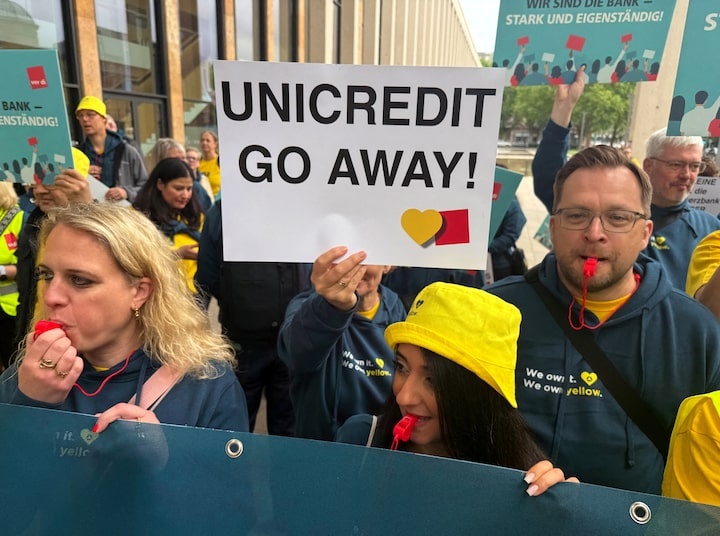

Germany’s government will not relinquish its stake in Commerzbank, a position that government sources say makes UniCredit’s takeover strategy unworkable, according to Reuters. The sources said Berlin’s continued ownership prevents UniCredit from executing its plan to merge Commerzbank with its German subsidiary, HypoVereinsbank. The development comes as UniCredit’s tender offer, launched on May 5, 2026, nears the end of its extended acceptance period on July 3.
UniCredit has built a position covering roughly 42% of Commerzbank’s total capital through a combination of direct equity, share-settled derivatives, and tendered shares, according to Bloomberg. That figure clears the 30% threshold that triggers mandatory takeover rules under German law. It falls well short, however, of the outright majority UniCredit needs to fully integrate Commerzbank’s balance sheet without facing capital penalties.
Germany’s government holds a roughly 12% stake in Commerzbank, acquired during the 2008 financial crisis bailout, according to Reuters. That holding has not been sold, despite earlier indications from Berlin that it might eventually divest. The state’s continued presence as a shareholder gives it seats on Commerzbank’s supervisory board, the body responsible for appointing management and overseeing strategy.
The German government’s finance agency, which manages the stabilization fund holding the stake, formally rejected UniCredit’s offer on June 16, when the initial tender window closed. “Accepting the offer was already not an option from a financial point of view, as it does not include an appropriate premium on the current share price of Commerzbank’s shares,” the agency said in a statement reported by Reuters.
Chancellor Friedrich Merz has criticized the Italian lender’s approach publicly. He said in May that the bid was destroying “trust” in Commerzbank, Germany’s second-largest private bank, according to Reuters.
Commerzbank Chief Executive Bettina Orlopp has disputed the legitimacy of UniCredit’s acceptance figures. She has argued that no major institutional investors and only a small fraction of retail shareholders accepted the offer on legitimate terms, with most tendered shares traced back to investment banks acting as counterparties to UniCredit’s derivative positions, according to Bloomberg.
UniCredit Chief Executive Andrea Orcel has framed the deal differently. “UniCredit believes that there is substantial value that can be unlocked within Commerzbank, either stand-alone or within UniCredit, for the benefit of Germany and the bank’s wider stakeholders,” he said in a UniCredit statement cited by Euronews.
The dispute has also drawn legal scrutiny. Frankfurt prosecutors confirmed on June 16 that they had opened a preliminary investigation into possible market manipulation tied to UniCredit’s use of derivatives to build its stake, according to Reuters. No details of the investigation have been made public.
Regional and global impact
For Germany, the standoff touches on questions of economic sovereignty over a systemically important lender. The government’s finance agency said it supports Commerzbank’s independence and that the bank plays a critical role in financing the country’s medium-sized Mittelstand companies, according to Reuters. The agency said in its statement that this role, along with Commerzbank’s position in Frankfurt as Germany’s financial hub, “must continue to be ensured in the future.”
For Italy and UniCredit, the outcome will shape whether Orcel can complete what Bloomberg has described as a long-running attempt to build a cross-border banking group spanning Italy and Germany. UniCredit has pointed to HVB’s performance metrics, including returns on assets, as evidence the Italian lender can manage German banking operations effectively.
The standoff also has implications for European Central Bank policy on cross-border bank consolidation. The ECB’s formal authorization for UniCredit to exceed the 30% ownership threshold remains pending and is not expected before the third quarter of 2026, according to reporting on the deal.
Background
UniCredit first disclosed a stake in Commerzbank in September 2024, when it acquired a 4.5% holding from the German government, later raising its position through further share purchases and derivatives. The Italian bank formally launched its tender offer for the remainder of Commerzbank’s shares on May 5, 2026, valuing the German lender at €37.33 per share based on an exchange ratio of 0.485 UniCredit shares per Commerzbank share. Commerzbank’s Board of Managing Directors and Supervisory Board reviewed the offer with independent advisors and recommended in May that shareholders reject it, concluding it did not reflect the bank’s fundamental value. Commerzbank has since unveiled its own “Momentum 2030” strategy, targeting a net return on equity of around 21% by 2030, as an alternative to the takeover. Under European Union accounting rules, UniCredit would face a capital ratio penalty if it gains legal control of Commerzbank without securing an outright majority of shares.
What happens next
UniCredit’s extended acceptance period for its tender offer is set to close on July 3, 2026. The European Central Bank’s decision on whether to authorize UniCredit’s stake above the 30% threshold is expected sometime in the third quarter of 2026. Frankfurt prosecutors have not indicated a timeline for their preliminary market manipulation investigation. Commerzbank’s supervisory board, where German government representatives currently hold seats, is expected to continue contesting UniCredit’s claim to appoint all shareholder representatives once the 30% threshold is confirmed.