
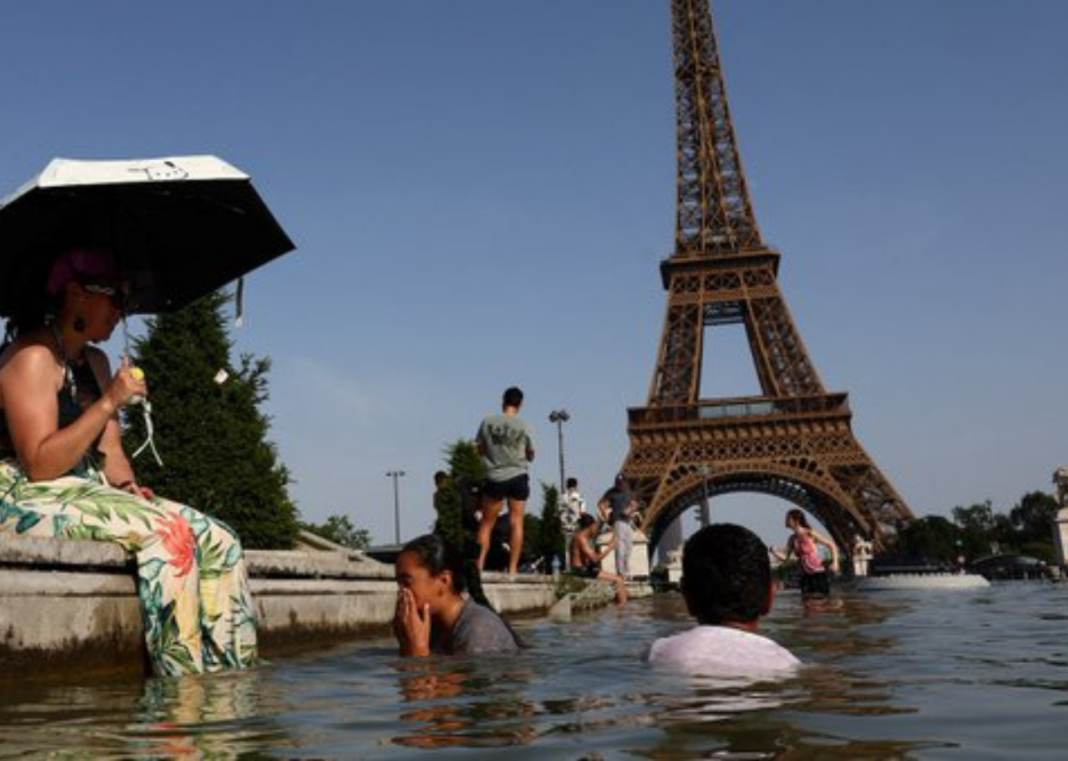

Power Cuts Leave Thousands Sweltering in Northern France as Record Heatwave Grips Western Europe
Authorities in northern France were scrambling on Wednesday, June 24, to restore electricity to thousands of homes hit by power cuts amid a blistering heatwave that has scorched much of western Europe for days. Power failed for about 68,000 households in northwestern France, including the Brittany region and Finistère, after a heat-related transformer incident that officials described as accidental. Geo News
“The incident was accidental and related to the current heat wave,” officials said in a statement. “No one was injured.” Healthcare centres and critical sites were prioritised in the restoration effort, with generators provided to retirement homes after Tuesday’s outages. Fox NewsFox News
A Day of Records
The blackout landed as Météo-France placed 54 mainland departments — roughly half the country — under a red heatwave alert affecting about 39 million people. Météo-France provisional data put the national thermal indicator at 29.3 degrees Celsius, France’s hottest day ever recorded and its hottest night on record during the same spell. Temperatures above 40C were recorded in some cities, and Paris was forecast to top 40C for the first time on a June day. Geo News + 2
France’s national temperature indicator — an average of daytime and nighttime temperatures across 30 stations — reached 29.8 degrees Celsius on Tuesday, the hottest reading since measurements began in 1947. More than 90 percent of the French population was exposed to extreme heat, with temperatures of 39C to 41C expected on Wednesday from Brittany to Paris and across much of the southwest. euronewseuronews
Up to 106,000 customers of the French power network were left without electricity by late Tuesday as scorching temperatures strained infrastructure built before climate change made heatwaves longer, more frequent and more intense, scientists said. Sales of fans and air conditioners skyrocketed across a country where most buildings are not designed to deal with extreme heat. euronewseuronews
A Stalled Weather System
Meteorologists said it was not certain how long the heatwave, driven by a weather pattern known as an Omega block — named for the shape that allows temperatures to build day after day — would last. The World Meteorological Organisation has said Europe is warming at more than twice the global average, making prolonged heat episodes increasingly likely. Fox NewsFox News
France’s national weather agency said the conditions were comparable to a heatwave in August 2003 that lasted 16 days and caused an estimated 80,000 excess deaths across Europe. northeastern
Disruption Across Daily Life
The heatwave has forced builders to alter working hours so employees can avoid the worst heat, while retailers have struggled to meet demand for fans and portable air conditioners and farmers have begun harvesting grain at night after a ban on afternoon field work because of fire risk. Dozens of people have drowned while trying to escape the heat by jumping into bodies of water. Fox NewsFox News
In southeastern France, two children aged two and four died in a hot car outside their family home; autopsies showed they succumbed to the excessive heat. Their mother said the children were in the car without her knowledge, the regional prosecutor said. northeastern
The Heat Spreads Across the Continent
In Britain, the grid operator asked generators to make more power available amid soaring temperatures poised to break records later on Wednesday. With temperatures in the high thirties, British health authorities issued a “red heat” health alert — only the second time the warning has ever been used — citing a risk to life for even healthy people, as well as the ill and elderly. Hundreds of British schools planned to close or close early during the week because of the heat, while many train services were reduced to avoid heat-related problems on the rail lines. British train operators advised only essential travel over Wednesday and Thursday, the two hottest days, as the heat forced speed restrictions on parts of the network. Fox News + 3
Italy’s Ministry of Health declared a red heatwave alert in 16 cities, including Milan and Rome, with the warning later extended to Florence, Turin, and Verona. In the coming days, the heatwave is expected to extend into Eastern Europe. Poland’s weather service issued high-level heat warnings for the western part of the country, predicting temperatures could break the national record of 40.2C set in 1921. Croatia’s Adriatic coast was placed under red alert, while Hungary raised its heat alert to maximum level. The Netherlands placed its central and southern regions under an orange code for extreme heat, and Belgium put the entire country under an orange heat alert as a record-breaking heatwave approached. euronews + 2
Forecasters said conditions were expected to worsen further across central and northern Italy, with the heatwave likely to peak between Sunday and Monday. Temperatures could reach 41C between Tuscany and Emilia, while in coastal areas such as Liguria the combination of heat and extreme humidity could drive perceived temperatures as high as 45C. Some relief was expected to begin in Spain on Wednesday, as the country’s State Meteorological Agency forecast temperatures dropping across most of the country. Fox Newseuronews
Regional and Global Impact
The strain on France’s electricity network illustrates a structural vulnerability shared across much of Western Europe: power infrastructure built decades ago for a more temperate climate is increasingly being tested by heat extremes that scientists attribute to human-driven climate change. The transformer failure in Brittany — described by officials as accidental and heat-related — reflects a pattern grid operators across the continent are likely to confront with greater frequency as heatwaves grow longer and more intense.
The simultaneous strain on Britain’s grid, where the operator requested additional generation capacity, points to a continent-wide test of energy infrastructure occurring in parallel rather than an isolated national event. The widening geographic spread of red and orange heat alerts — from France and Britain to Italy, Poland, Hungary, Croatia, the Netherlands, and Belgium — signals a heatwave event of a scale and reach that meteorologists are already comparing to the catastrophic 2003 European heatwave, a comparison that carries significant public health implications given the scale of excess mortality recorded during that earlier event.
Background
The August 2003 European heatwave remains the benchmark against which subsequent extreme heat events on the continent are measured, having caused an estimated 80,000 excess deaths across Europe over a 16-day period. Following that event, several European governments implemented heat action plans, including expanded early-warning systems and adaptations to building codes and public health protocols. France’s weather agency, Météo-France, has progressively lowered the threshold for declaring red heatwave alerts in subsequent years as climate scientists have documented a clear warming trend across the country. The World Meteorological Organisation has repeatedly stated that Europe is warming faster than the global average, a trend attributed to a combination of atmospheric circulation patterns and the continent’s geographic exposure to both Arctic and Mediterranean climate influences.
What Happens Next
French authorities are continuing efforts to fully restore power to all affected households in Brittany and Finistère, with healthcare facilities and retirement homes remaining the top priority. Météo-France’s red alert covering 54 departments remains in effect, with the heatwave’s national peak still developing. In Italy, meteorologists expect the heatwave to peak between Sunday and Monday, with the most extreme conditions forecast for Tuscany, Emilia, and Liguria. Poland, Croatia, Hungary, the Netherlands, and Belgium are all bracing for the heatwave’s eastward extension over the coming days, with several national weather services warning of potential record-breaking temperatures.