
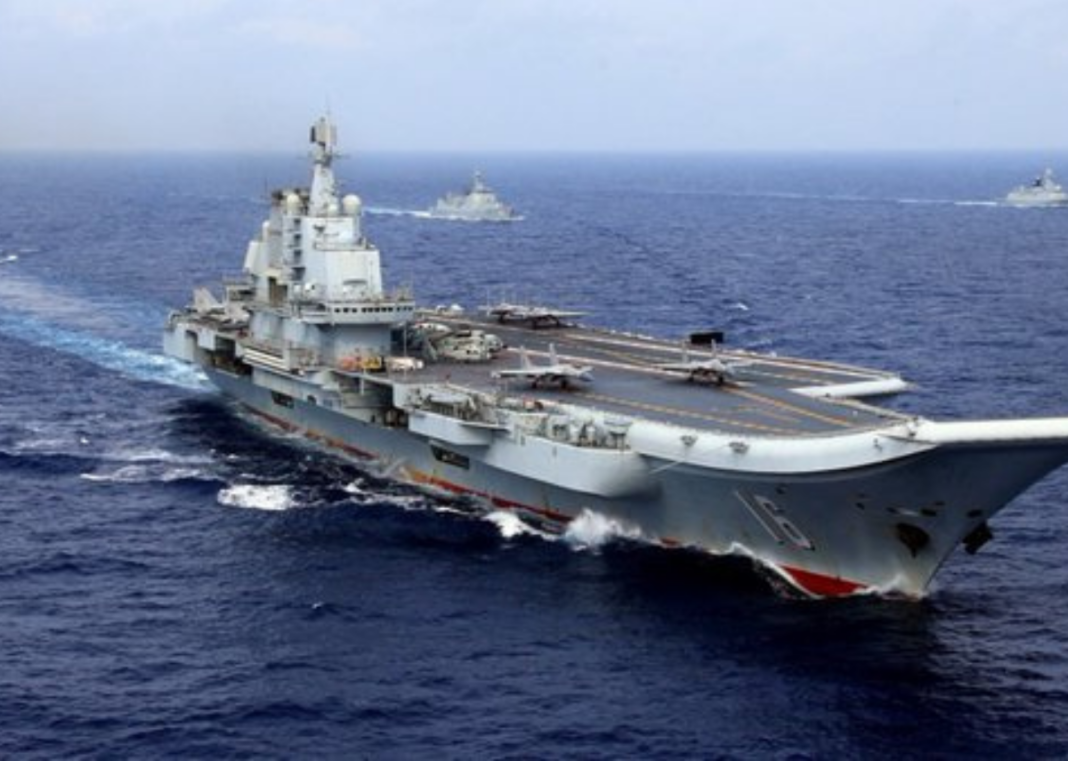

China’s Liaoning Carrier Strike Group Returns to Qingdao After 40-Day Western Pacific Deployment, Accusing Japan of Repeated Provocations
China’s Liaoning aircraft carrier and its accompanying strike group returned to their home port of Qingdao on Monday, June 22, after completing more than 40 days of combat training drills in the South China Sea and the western Pacific Ocean, Chinese state broadcaster CCTV reported. The training focused on combat readiness, including air defence, anti-ship strikes, support missions, long-range rescue, and live-fire exercises. The group carried out multiple rounds of ship-air offensive and defensive drills, and conducted joint exercises with an amphibious assault ship group in the western Pacific Ocean to enhance coordination in far-sea operations. tradingeconomics
The return of the carrier group was accompanied by a pointed accusation against Japan. CCTV released a video on Monday showing at least four “close-range” encounters and said the Liaoning carrier group had “warned off” warships and surveillance planes it described as having engaged in harassment. It included footage of Japanese warships as well as clips of aircraft. https://eutoday.net
What the Drills Involved
CCTV said that during the training, the Liaoning carrier group “professionally and prudently” handled what the broadcaster called “repeated close-range tracking, harassment, and provocation” by Japanese ships and aircraft. Beijing did not disclose the specific locations or dates of these encounters. Japan had not responded to the accusations as of Monday. tradingeconomics
The carrier strike group was detected on May 29 approximately 590 kilometres southeast of Miyako Island, transiting into the Philippine Sea, having performed naval drills while cruising off the coast of the main Philippine island of Luzon over the previous week. Global Banking and Finance
The deployment’s composition was notable. A newest-generation Type 054B frigate was observed for the first time escorting the carrier alongside a Type 901 fast combat support ship and a Type 055 destroyer, leading some analysts to assert that the PLA Navy was developing a layered naval formation designed to mirror that of a United States Navy carrier strike group. Global Banking and Finance
The Liaoning’s air wing has been progressively upgraded, with J-15B enhanced fighters and J-15D electronic attack aircraft confirmed as having been integrated into its air wing — significantly improving its offensive and electronic warfare capabilities compared to earlier deployments. MarketScreener
Japan’s Earlier Monitoring
In early June, Japan’s defence ministry said it had monitored the Liaoning aircraft carrier and accompanying vessels operating east of the Philippines’ Luzon island in late May. The Japanese Maritime Self-Defence Force tracked the carrier group’s movements throughout the deployment, and Tokyo had already protested a December 2025 incident in which J-15 fighters from the Liaoning locked their fire-control radars onto Japanese F-15 aircraft over international waters southeast of Okinawa. tradingeconomics
Japan’s Defence Minister Shinjiro Koizumi denounced that December incident as “a dangerous act that exceeded the range necessary for safe aircraft flight,” while a Chinese navy spokesman retorted that the Japanese planes had repeatedly approached the Chinese naval task force in a deliberate attempt to disrupt their training exercises. MarketScreener
A Deployment Pattern With Clear Strategic Intent
The 40-day exercise was the latest in an accelerating pace of Liaoning deployments, each one more complex and geographically ambitious than the last. The deployment, announced after exercises began on May 19, highlights how China is steadily improving its capacity to sustain carrier operations beyond the First Island Chain and challenge US and allied freedom of manoeuvre across the Indo-Pacific. euronews
China’s latest naval movements suggest Beijing is doing far more than routine training. The southward passage of the Liaoning, combined with the deployment of a PLA Navy task group into the western Pacific, points to a broader strategic design: signalling resolve to Japan, countering the Philippines-US Balikatan exercise — which this year saw a record level of participation by Japan — and shaping the military balance ahead of possible high-level diplomacy with Washington. 93.3 The Drive
In early June 2025, Liaoning had carried out training exercises together with aircraft carrier Shandong in the Philippine Sea — the first time two Chinese carriers operated together beyond the First Island Chain. This year’s 40-day solo deployment, with Shandong undergoing refurbishment and the Fujian still not fully operational, demonstrated that the PLA Navy has built enough operational depth to sustain extended blue-water carrier deployments even when its most advanced hulls are unavailable. Global Banking and Finance
The Ski-Jump Constraint — and What It Still Achieves
Unlike US Navy nuclear-powered aircraft carriers equipped with catapult-assisted launch systems, the Liaoning’s ski-jump configuration limits aircraft takeoff weight and reduces the fuel and weapons load that J-15 fighters can carry during launch operations, constraining sortie rates and operational reach compared to American carrier air wings. euronews
The Liaoning has on multiple occasions demonstrated the ability to launch rapid sorties near major targets — in May 2022, for example, it launched over 100 sorties near US military facilities in Okinawa. The future of the ship’s air wing, including whether it will integrate J-35 stealth fighters and new types of unmanned combat and support aircraft, remains uncertain, though rapid continued modernisation is expected. MarketScreener
Background
The Liaoning was originally laid down in 1985 for the Soviet Navy as the Kuznetsov-class carrier Riga, launched in 1988, and renamed Varyag in 1990. After the dissolution of the Soviet Union in 1991, construction halted and Ukraine sold the stripped hulk to China in 1998. It arrived at China’s Dalian naval shipyard in 2002 and was commissioned into the PLA Navy in 2012, initially as a training ship. Following upgrades and additional training, Chinese state media announced in late 2018 that the ship would shift to a combat role, which it formally assumed in 2019. China’s Foreign Ministry spokesperson Guo Jiakun stated at a regular press briefing during the deployment that the Taiwan issue is a non-negotiable “red line” and criticised the entry of Japanese naval vessels into what Beijing considers sensitive waters — diplomatic messaging that ran in parallel with the carrier’s operational movements throughout the 40-day exercise. Global Banking and Finance93.3 The Drive
What Happens Next
Japan’s defence ministry had not issued a formal response to China’s accusation of repeated harassment as of Monday evening. Whether Tokyo will lodge a diplomatic protest over the specific encounters documented in CCTV’s footage — or respond through its own public military communications — will be an early indicator of how the two sides manage the latest round of maritime friction. At least two further Chinese supercarriers, including China’s first nuclear-powered supercarrier, are currently under construction — deployments that, once operational, will give the PLA Navy a substantially greater capacity to sustain multiple concurrent carrier strike group operations in the western Pacific simultaneously. For now, the Liaoning’s 40-day deployment stands as the most extended and operationally complex far-sea exercise the carrier has completed, and its safe return to Qingdao will be treated by Beijing as a demonstration of growing blue-water endurance. MarketScreener