
All MV Hondius Passengers Classed as High-Risk Hantavirus Contacts
The Dutch cruise ship MV Hondius docked at the port of Granadilla in Tenerife, Spain, on Sunday, May 10, triggering a multinational repatriation operation after Europe’s top public health agency classified every passenger on board as a high-risk contact of a deadly hantavirus outbreak. The MV Hondius had people, on board who could have caught the hantavirus. Eight people have fallen ill, including three deaths, with all six laboratory-confirmed cases identified as the Andes strain of hantavirus. The outbreak has drawn responses from health authorities across at least nine countries and placed 147 passengers and crew under formal international health monitoring. who
The European Centre for Disease Prevention and Control (ECDC) said on Saturday that passengers without symptoms would be repatriated for self-quarantine via specially arranged transport — not regular commercial flights — by their respective countries. The European Centre, for Disease Prevention and Control said that each person will be taken care of by their country. The classification of the full passenger list as high-risk contacts, issued as part of the ECDC’s rapid scientific advice, is a precautionary measure and does not mean every individual is expected to develop the disease. The Detroit News
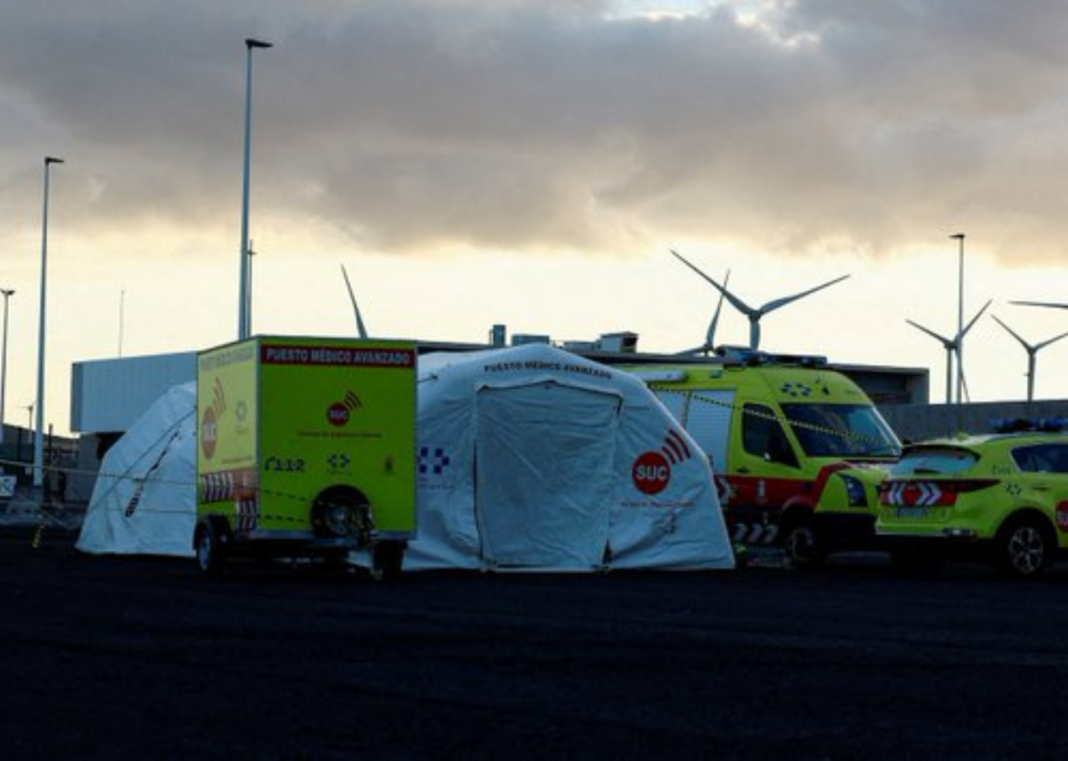
Medical teams boarded the ship before disembarkation began to run tests on passengers and crew, Spanish Health Minister Mónica García said shortly before 8 a.m. local time on Sunday. Passengers were ferried from the anchored vessel to the island in small boats, then loaded onto waiting buses headed for the airport. CNN
Spanish passengers disembarked first and were flown to Madrid to quarantine at the Gomez-Ulla military hospital. The Netherlands dispatched two planes — one on Sunday and a second “sweeper plane” on Monday — to collect Dutch nationals and any passengers not collected by their own governments. Repatriation flights were arranged for passengers travelling to Canada, Turkey, France, Great Britain, Ireland, and the United States, García confirmed. ABC News
García stated Sunday morning: “The entire operation is proceeding normally and I said the first to disembark will be the Spanish citizens, and then the flight to the Netherlands will depart. But in principle, throughout today and tomorrow, all the planes of all nationalities will be disembarked and taken back to their respective countries.” ABC News
The ECDC’s guidance requires high-risk contacts to self-quarantine and carry out daily symptom monitoring for up to 42 days, with day zero counted from May 6. Those who develop symptoms must be tested. Low-risk contacts face a less stringent passive monitoring regime and are instructed to isolate and seek testing only if symptoms appear. European Centre for Disease Prevention and Control
WHO Director-General Tedros Adhanom Ghebreyesus travelled to Tenerife personally to oversee the operation. In a message to the island’s residents published on Saturday, he said: “The virus aboard the MV Hondius is the Andes strain of hantavirus. It is serious. Three people have lost their lives, and our hearts go out to their families. The risk to you, living your daily life in Tenerife, is low. This is the WHO’s assessment, and we do not make it lightly.” WHO
Spain’s interior minister Fernando Grande-Marlaska said 358 Spanish security force agents were deployed for the transfer operation. Disembarkation was conducted by nationality, with each group leaving the ship only when the corresponding repatriation aircraft was on the runway and ready to depart. CNN
The US Centers for Disease Control and Prevention dispatched epidemiologists to Tenerife to conduct individual risk assessments on American passengers. A US Department of Health and Human Services official said Saturday that the current assessment is that the risk to the broader American public remains “extremely low.” The 17 American passengers remaining on board were set to be repatriated on a US government medical flight to Nebraska, where they would be received at the National Quarantine Unit at the University of Nebraska Medical Center. CNNWikipedia
The CDC classified the outbreak as a “level 3” emergency response, while the Dutch National Institute for Public Health designated it a level A2 infectious disease. Five US states — Arizona, California, Georgia, Texas, and Virginia — were already monitoring passengers who had left the ship at earlier ports. Wikipedia
The outbreak began after the MV Hondius departed Ushuaia, Argentina, on April 1. The working hypothesis, according to WHO, is that the first case most probably acquired the infection prior to boarding through environmental exposure during activities in Argentina. Current evidence then points to subsequent human-to-human transmission onboard, given documented epidemiological links between the index case and later patients and the timing of symptom onset clustering around known incubation periods for the Andes virus. who
The current hypothesis is that passengers were exposed to the Andes virus while spending time in Argentina before embarking, where it is endemic, and may subsequently have transmitted it to others on board. Three of the dead are a Dutch couple and a German national, according to WHO. European Centre for Disease Prevention and Control
The geopolitical dimension of the outbreak was visible in the negotiations over where the ship could dock. The president of the Canary Islands, Fernando Clavijo, objected to the ship’s arrival out of concerns for the islanders’ safety. Spain ultimately approved the plan in what its health agency described, Reuters reported, as consistent with international law and humanitarian principles. The regional government of the Canary Islands also suggested to the Dutch delegation that the ship should continue to the Netherlands after disembarkation, with the same crew. WikipediaCNN
The Andes virus is a hantavirus primarily found in South America that causes hantavirus pulmonary syndrome with a high fatality rate. No effective antiviral treatment is available; supportive care is key for survival. The virus is the only known hantavirus capable of person-to-person transmission, though this has historically occurred only through close and prolonged contact. WHO assessed the global public health risk from the event as low, while rating the risk for passengers and crew on the ship as moderate. European Centre for Disease Prevention and Controlwho
Illness onset among cases occurred between April 6 and April 28 and was characterised by fever, gastrointestinal symptoms, rapid progression to pneumonia, acute respiratory distress syndrome, and shock. The case fatality ratio among those who fell ill stands at 38%, according to WHO’s May 8 update. WHO
The local Canary Islands government urged that the evacuation be completed before Tuesday, when weather conditions were expected to deteriorate, with rougher seas and stronger winds forecast. The Canary Islands government is worried that it will be very hard to evacuate people when the weather’s bad. Following the disembarkation of all passengers, at least six repatriation flights to EU destinations and four non-EU flights were planned. All returning passengers classified as high-risk contacts face a potential quarantine and monitoring period of up to six weeks from their last date of exposure. Epidemiological investigations into the index case’s travel route through Argentina, Chile, and Uruguay are ongoing, with Argentine authorities capturing and testing rodents along the route the first patient travelled, according to Wikipedia’s account citing Argentine health ministry sources.