
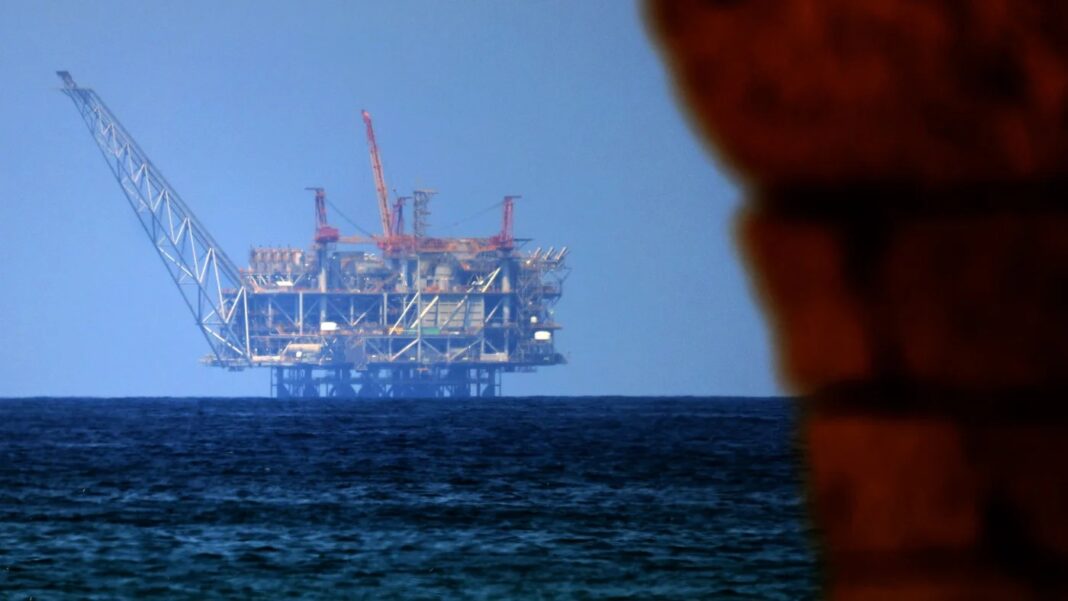

Israeli energy authorities have granted offshore gas exploration licences covering areas that rights groups say fall within recognised Palestinian maritime territory off the coast of Gaza, drawing condemnation from legal advocates and environmental organisations. In February 2026, Israeli Energy Minister Eli Cohen approved the country’s fifth offshore gas licensing round in the Mediterranean, covering approximately 8,600 square kilometres of sea divided into six search zones. Adalah, a Haifa-based legal centre focused on Palestinian rights, said two of those six zones encroach on Palestinian waters.
Adalah sent a formal letter last month to Cohen and Attorney General Gali Baharav-Miara, arguing that around 1,000 square kilometres of the designated exploration area lies within waters claimed by the State of Palestine. The letter, shared with Middle East Eye, stated that Israel “has no authority to operate” in Palestinian maritime areas and that proceeding would breach both Israeli and international law. Adalah urged the government to halt the exploration plans entirely.
The legal centre argued that Israel cannot use “its ongoing illegal occupation as justification for denying the sovereign rights of the State of Palestine and the Palestinian people,” according to the letter. It also said the plans violate the Oslo Accords signed with the Palestinian Authority in 1993, as well as international humanitarian law, which prohibits occupying powers from exploiting natural resources in territories under occupation.
Suhad Bishara, Adalah’s legal director, said the offshore drilling plans “cannot be separated from the broader accelerated Israeli policy aimed at establishing annexation and control over Palestinian land and resources.” In a public statement, Bishara said the licensing round was not merely a legal violation but “an attempt to establish permanent control over Palestinian land and resources” in a way that undermines Palestinian self-determination.
Israel’s Ministry of Energy and Infrastructure had not responded to a request for comment from Middle East Eye by the time of publication. The ministry has also not released the results of the licensing round since the tender was announced.
Profit Over Need, Critics Say
Environmental advocates have added their voice to the criticism. Yuval Arbel of the Zalul Environmental Association, an Israeli organisation focused on protecting seas and water resources, said Israel already produces enough gas to cover domestic energy needs. “There is no need to increase gas production. Instead, there should be a transition to renewable energy,” Arbel told Middle East Eye.
Arbel said the energy ministry assumes renewables alone will not meet future demand, but he contended that profit also drives the push. “If gas is extracted from these sites, it will only happen in another six to 10 years,” he said. “Who knows whether there will still be demand for gas in 10 or 15 years.” He accused the ministry of seeking to “maximise profits,” adding: “There is no real benefit for Israel in extracting more gas other than the revenues flowing into the state through exports.”
His warnings carry weight given the scale of Israel’s gas revenues. According to the Israeli Ministry of Energy and Infrastructure, 2024 saw record earnings from gas production, with the state collecting 2.3 billion shekels — approximately $640 million — in royalties, an increase of more than eight percent on the previous year. Israel currently operates multiple offshore gas fields through a mix of international and local energy companies. UK-based Energean and US energy major Chevron are among the international firms active in Israeli gas operations. Last year, BP and Azerbaijan’s state energy company SOCAR won bids in Israel’s fourth offshore licensing round, which critics also said encroached on Palestinian sovereignty.
Arbel warned that the environmental cost of further drilling could far outweigh any economic gain. “The potential damage from gas drilling is so great that even if the likelihood of a catastrophic event is relatively small, it is not worth taking the risk,” he said.
West Bank Infrastructure and Settlements
The offshore licensing dispute sits alongside a broader set of Israeli energy moves in occupied territory. Last week, Cohen announced plans to extend natural gas infrastructure into the occupied West Bank. “We are applying sovereignty in practice,” he said. The project would route gas from the Mediterranean to Israeli settlements in the West Bank.
Earlier this week, Cohen told Channel 14 News that his ministry was planning new power plants and gas pipelines across the West Bank, describing the move as “the economic key on the path to one million” settlers living in the territory. Since taking office in 2024, Cohen has pursued policies aimed at consolidating Israeli control over occupied Palestinian territory, in line with demands from the settler movement, according to Middle East Eye’s reporting.
Gas has become Israel’s dominant fuel for electricity. A Knesset report found that gas accounted for more than 70 percent of Israeli electricity production by 2024, up from around 49 percent a decade earlier, with coal and renewables each making up roughly 14 percent.
Background
Since the early 2000s, Israel has blocked the Palestinian Authority from accessing the Gaza Marine gas field, which experts estimate holds up to 30 billion cubic metres of gas, according to The Guardian. That field is estimated to be worth up to $4 billion to the Palestinian Authority. Adalah said Israel also exports billions of dollars worth of gas to Egypt through the Ashkelon-Arish pipeline, which passes through Palestinian maritime territory without Palestinian consent. Before the war that began in October 2023, Palestinians sourced 87 percent of their electricity from Israel, with the remainder coming from Egypt, Jordan, and local solar generation, according to the Institute for Palestine Studies. Since October 2023, Israel has destroyed much of Gaza’s energy infrastructure, causing near-total electricity blackouts throughout 2024, the UN Office for the Coordination of Humanitarian Affairs reported.
What Happens Next
Adalah’s letter to the attorney general and energy minister remains unanswered, and the group has called on Israeli authorities to cancel the licences for zones within Palestinian waters. The energy ministry has not published results from the fifth licensing round, leaving the status of the contested zones formally unresolved. Cohen’s announced West Bank gas pipeline expansion is moving toward the planning stage, according to his statements to Channel 14 News. International energy companies holding or seeking Israeli offshore licences may face legal pressure; Middle East Eye has previously reported that energy firms have received formal legal threats over their involvement in Israeli offshore operations near Gaza.