
North Korea’s Kim Oversees Weapons Tests Demanding “Deadly and Destructive Offensive Posture”
North Korean leader Kim Jong Un oversaw tests of key weapons on Thursday, June 25, as part of the country’s goal to modernise its missile programme and bolster firepower along the southern border with South Korea, state media KCNA reported on Friday. The tests were conducted on the anniversary of the outbreak of the 1950-53 Korean War. Crypto BriefingCrypto Briefing
The tests involved an upgraded version of a 240-mm, 24-tube multiple rocket launcher system, tactical ballistic missiles, and a 155-mm self-propelled howitzer, KCNA said. The weapons tested included a “special mission” ballistic missile warhead, an upgraded rocket launcher with an extended firing range, and a self-propelled gun-howitzer, the AP news agency reported. Crypto BriefingABC News
A Demand for “Constant Unease and Fear”
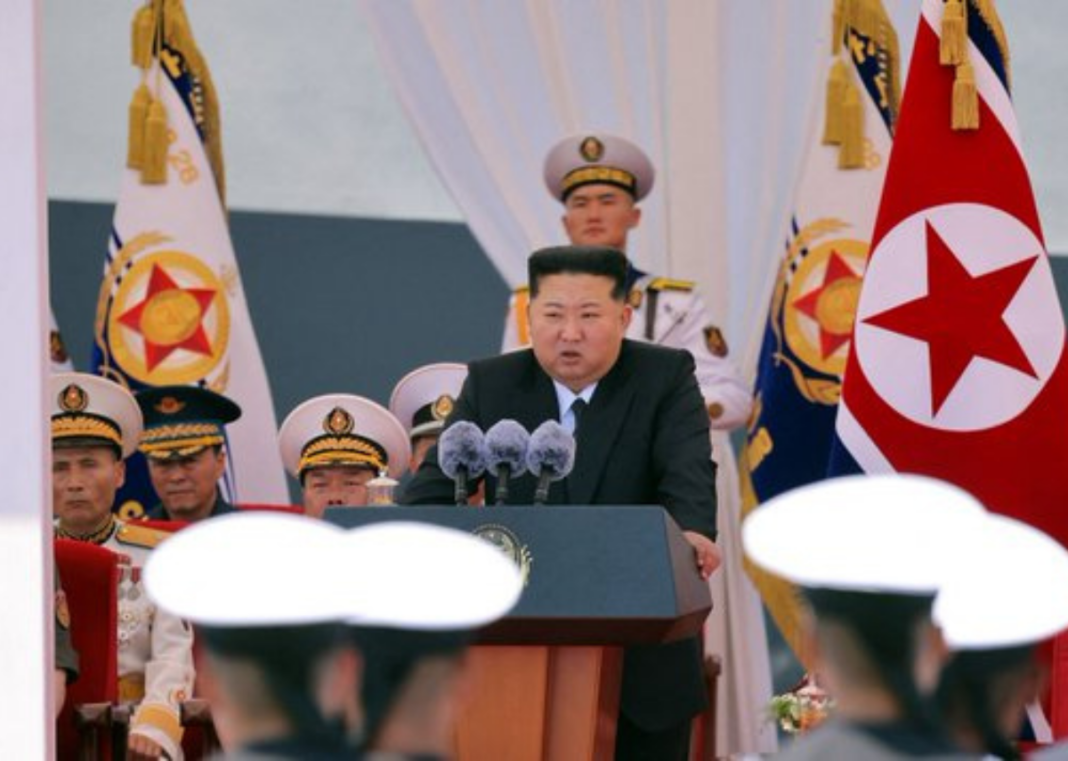
Kim demanded that the military ensure his country’s “enemies feel constant uneasiness and fear” — an important aspect of war deterrent — and dare not attack. Kim Jong Un called for the country to adopt a “deadly and destructive offensive posture,” state news agency KCNA reported. North Korea’s leader was quoted saying: “To make the enemies feel constant uneasiness and fear is just an important aspect of the exercise of war deterrent.” ABC News + 2
Kim, expressing satisfaction with the test results, said Pyongyang was pursuing automation, long-range capability and “ultra-precision” in its weapons programmes, according to KCNA. The goal is for its defence along its southern border, Kim said, effectively referring to the one with South Korea. Crypto BriefingCrypto Briefing
The Technical Specifications
The upgraded rocket launcher is equipped with an autonomous precision guidance system, with its firing range extended to 90 kilometres (56 miles), the media report said. KCNA called the system an “improved corps-level firepower system.” KCNA said the warhead aimed to inflict “fatal damage on major targets including airfields, ports and power facilities of the enemy.” Crypto Briefing + 2
North Korea also conducted a test of 65-kilometre extended-range shells for the 155-mm self-propelled howitzer. Experts said if North Korea’s claim is true, the howitzers could put Seoul within striking range. The North did not elaborate further on the warhead’s design, but experts raised the possibility of testing cluster or armour-piercing munitions, capable of striking relatively wide areas. Washington TimesWashington Times
Part of a Broader Modernisation Drive
The North’s leader supervised the test of “important weapons” as part of the country’s project to modernise its artillery and missile forces under a five-year defence development plan, according to KCNA. In May, North Korea said it had tested a mix of tactical ballistic missiles, artillery rockets, and AI-guided precision cruise missiles designed for modern warfare. Washington TimesCrypto Briefing
Pyongyang has been steadily upgrading its tactical and conventional arsenal, vowing to deploy weapons near the border with South Korea. The tests came just two days after another show of military strength: Kim Jong Un told a commissioning ceremony in Nampho on June 23 that warships such as the new destroyer Choe Hyon prove the nuclear armament of North Korea’s navy is progressing as planned, according to state media. Crypto BriefingABC News
Analyst Assessment
Lim Eul-chul, a professor at Kyungnam University’s Institute for Far Eastern Studies, said the moves point to accelerating efforts to fortify the southern border and integrate nuclear and conventional forces as North Korea cements what it calls a relationship of two hostile states. Crypto Briefing
South Korea’s Parallel Response
Seoul said on Friday that it is building an army of “drone warriors” after Kim observed the previous day’s tests. The South’s announcement reflects an ongoing pattern in which Seoul has responded to Pyongyang’s conventional and tactical weapons advances with its own modernisation efforts, including emerging unmanned and drone-based capabilities, rather than relying solely on legacy conventional deterrents. ABC News
Regional and Global Impact
The timing and content of Thursday’s tests — conducted on the anniversary of the Korean War’s outbreak and explicitly framed by Kim as aimed at strengthening North Korea’s posture against South Korea — reinforce a trajectory that has hardened steadily since Pyongyang formally redefined inter-Korean relations as those between “two states hostile to each other” in late 2023. The specific emphasis on extending firing ranges to bring more of South Korean territory, including potentially Seoul, within striking distance signals an intent to expand the operational reach of North Korea’s conventional and tactical arsenal rather than relying exclusively on its strategic nuclear deterrent.
The tests follow North Korea’s broader pattern of weapons development, after talks between Pyongyang and Washington stalled in 2019. The United States maintains several military bases in South Korea, hosting about 28,500 personnel, a presence that remains central to the deterrence calculations both Seoul and Washington apply when assessing North Korea’s evolving conventional and missile capabilities. The continued upgrades come against the backdrop of North Korea’s recent statements declaring its denuclearisation status “irreversibly finalised” and its expanding military cooperation with Russia, both of which have intensified Western and South Korean concern about the trajectory of the North’s overall military posture. Crypto BriefingABC News
Background
North Korea has pursued sustained military modernisation since the collapse of denuclearisation talks between Kim Jong Un and then-US President Donald Trump at the 2019 Hanoi summit. Pyongyang formally redefined its relationship with Seoul as one between “two states hostile to each other” in late 2023, abandoning earlier framing of the two Koreas as a single nation pursuing eventual reunification. North Korea has continued to develop and test a range of tactical and strategic weapons systems in the years since, including ballistic missiles, artillery systems, and naval vessels, while maintaining its position — reaffirmed as recently as mid-June 2026 — that its status as a nuclear weapons state is permanent and non-negotiable.
What Happens Next
North Korea is expected to continue testing and refining its conventional and tactical weapons systems under its stated five-year defence development plan, with further demonstrations likely to be reported by KCNA in the coming months. South Korea’s development of its “drone warriors” programme is expected to continue as part of its response to the North’s conventional weapons advances. Analysts will be watching closely for further indications of how North Korea intends to integrate its nuclear and conventional forces along the inter-Korean border, a dynamic that Kyungnam University’s Lim Eul-chul and other regional security analysts say is accelerating.