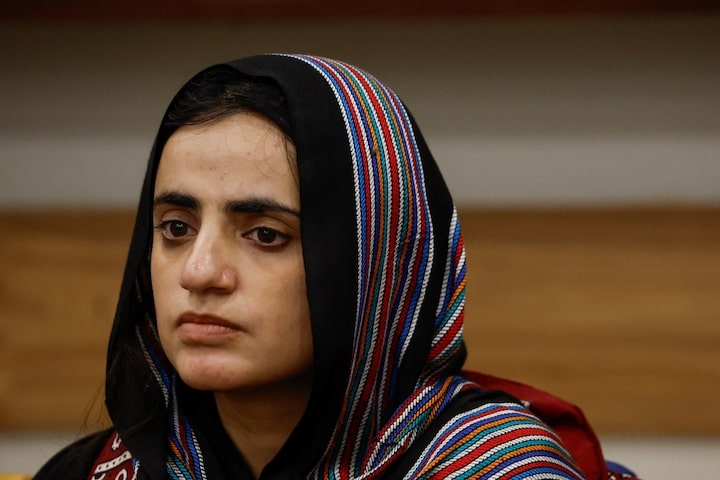

An anti-terrorism court in Quetta, Pakistan, sentenced prominent civil rights activist Mahrang Baloch and fellow activist Sibghatullah to life in prison on Monday, June 23. The court convicted them over the killing of a paramilitary soldier during a protest in the port city of Gwadar in July 2024. Both were found guilty of murder and terrorism-related offences linked to the death of Shabbir Ahmed, a paramilitary soldier.
Baloch, 33, who heads the Baloch Yakjehti Committee (BYC) rights group, was placed under administrative detention by the Balochistan provincial government on March 22, 2025, accused of terrorism, sedition, and murder after leading a protest. She was arrested by police in the early hours of that day while participating in a peaceful sit-in protest in Quetta.
The court also fined Baloch and Sibghatullah two lakhs each, payable to the victim’s family. The sentencing ordered both to pay a fine of 200,000 Pakistani rupees to Ahmed’s heirs, roughly $720.
Prosecutors said the case centered on a speech Baloch delivered during the 2024 demonstrations. According to the prosecution, Mahrang Baloch gave a speech that incited protesters to attack a security forces vehicle. The case stemmed from the death of an FC personnel during the protest in Gwadar that turned violent. In its ruling, the anti-terrorism court in Quetta said Baloch and Sibghatullah had been “active in the illegal gathering of the Baloch Unity Committee and had common objectives in the murder of the Federal Constabulary official.”
The defense rejected the legitimacy of the proceedings from the outset. Prosecutors accused the pair of inciting a mob attack, while Baloch and her legal team denied the charges, boycotted proceedings, and alleged violations of due process. “Dr. Mahrang’s case was shifted from an open court to a jail trial, and from the jail it was shifted to a faceless trial,” said Nadia Baloch, the activist’s sister and a member of her legal team. According to Nadia Baloch, no one knew the locations from where the judge, prosecutor, and witnesses participated.
Baloch’s lawyer, Israr Jattak, said on Wednesday the verdict would be challenged in the Balochistan High Court.
Balochistan’s provincial government defended the verdict as a legitimate application of the law. Sarfaraz Bugti, the chief minister of Balochistan province, said justice had been served for Sepoy Shabbir Baloch, who was killed by protesters while on duty in Gwadar. “Those who take the law into their own hands under the guise of peaceful protest, promote violence, and target state officials are in fact facilitators of terrorism,” Bugti said.
The verdict drew sharp criticism from Pakistani and international human rights organizations. The Human Rights Commission of Pakistan called for an immediate review of the verdict, saying the state had “continued its policy of treating fundamental rights advocacy in the same way it treats extremism, resulting in administrative and judicial decisions that are one-sided and biased.” Swedish climate activist Greta Thunberg also weighed in on the case. She criticised the proceedings, calling the trial a “mockery of justice” carried out “in utter secrecy” and alleging that Pakistani authorities were using legal action to suppress dissent.
Regional and Global Impact
The ruling has triggered protests and political reaction across Balochistan. BYC organiser Lala Abdul Baloch called it a “faceless” trial and warned more Baloch youth would likely choose resistance. “When you close access to the corridors of justice then more people will rise up against the state,” he said, adding the group has called a province-wide strike to protest the court’s decision.
Several civil society figures argue that her conviction risks further escalating tensions in the province. For Gul Rehman Hamdard, a well-known human rights activist, the sentence constitutes punishment for people who struggle for political and cultural rights, and the demands of Pakistan’s ethnic groups require greater democratic representation and political dialogue rather than repressive measures.
International figures have also raised concerns about due process. Tara Chand, president of the Baloch American Congress, wrote to U.S. President Donald Trump expressing grave concern over the life imprisonment handed to Baloch, saying the verdict undermines due process and the rights of peaceful political activists.
Background
A trained doctor, Mahrang Baloch became in recent years the most recognisable face of the campaign for the rights of ethnic Balochis, who live mostly in Pakistan’s southwestern province, a region rich in natural resources but marked by severe poverty and decades of conflict between the central government and armed separatist groups. For years, Islamabad has responded to calls for autonomy with increasing repression and militarisation, while pro-independence groups have carried out increasingly sophisticated attacks, often against law enforcement and foreign economic interests in the region. Mahrang Baloch has been in prison since March of last year, when she was arrested in the wake of the attack on the Jaffar Express that resulted in the deaths of 26 people. Over the years, Mahrang Baloch has received international recognition for her activism, appearing on the BBC’s list of the 100 most influential women and on TIME100 Next, a list of emerging personalities from around the world.
What Happens Next
Baloch’s lawyer, Israr Jattak, confirmed the verdict will be challenged in the Balochistan High Court. The BYC has called a province-wide strike in response to the court’s decision. Mahrang Baloch’s legal team has said it will continue to demand a fair and transparent trial as part of the appeal process. The Human Rights Commission of Pakistan has urged an immediate review of the case, though no formal government response to that request has been reported.