

China Launches Shenzhou-23 With First Hong Kong Astronaut in Record Year-Long Mission
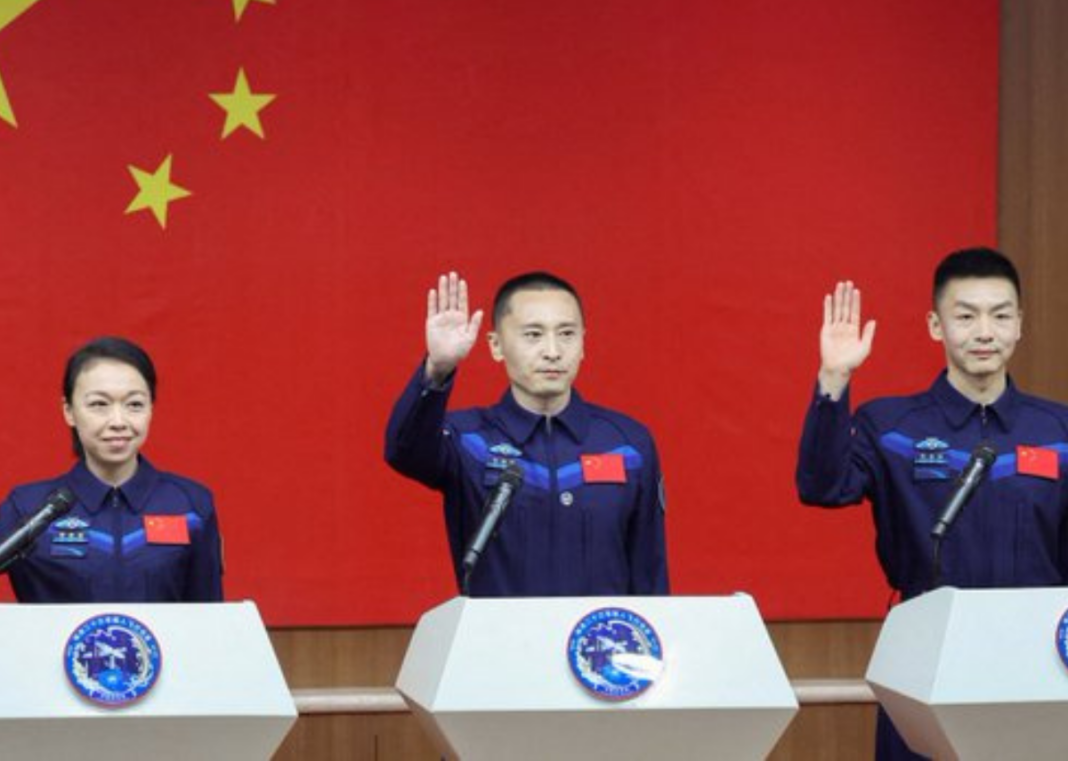
China launched the Shenzhou-23 crewed spacecraft on Sunday from Jiuquan Satellite Launch Center in northwest China, sending three astronauts to the Tiangong space station for a mission that will see one crew member remain in orbit for a full year — a record for the country. Aboard were commander Zhu Yangzhu, pilot Zhang Zhiyuan, and payload specialist Lai Ka-ying, who became the first astronaut from Hong Kong to travel to space. The mission is a key step in Beijing’s preparations for a crewed Moon landing by 2030, Reuters reported. Al JazeeraThe Jamestown Foundation
The Shenzhou-23 vessel lifted off at 11:08 p.m. Beijing time using the Long March-2F Y23 carrier rocket. Al Jazeera
The Crew
Commander Zhu Yangzhu flew for the first time on the Shenzhou-16 mission in 2023. Pilot Zhang Zhiyuan and payload specialist Lai Ka-ying are both making their first trips to space, drawn from China’s fourth batch of astronaut recruits. The Jamestown Foundation
Lai Ka-ying previously worked in the Hong Kong Police Force before being selected as an astronaut candidate in 2024. Her selection reflects Beijing’s effort to integrate Hong Kong more formally into its national space programme. The Jamestown Foundation
At a press conference on Saturday, Zhu spoke of the crew’s cohesion. “We think with one mind and pull in the same direction,” he said. Zhang offered a broader reflection. “From having a dream to realizing it is a long journey paved with faith and perseverance,” he said, adding three pieces of advice: rooting dreams in solid ground, turning passion into resilience, and linking personal ambition with national purpose. WSLS 10 NewsWSLS 10 News
The Year-Long Stay
An astronaut from the Shenzhou-23 crew is set to carry out a one-year in-orbit stay experiment. The specific astronaut selected for the year-long stay will be determined based on how the mission unfolds in orbit, the China Manned Space Agency said. Al Jazeera
During the year-long residency, China will implement its first space-based human body research program to collect crucial data on astronauts exposed to long-duration spaceflight environments. The mission will explore human adaptability and performance limits, aiming to establish a multi-system, multi-omics atlas of the human body in space. Al Jazeera
The agency’s spokesperson, Zhang Jingbo, was explicit about what the extended duration means scientifically. “Assigning an astronaut to a one-year in-orbit stay is not simply doubling the duration of two six-month missions,” Zhang said, adding that the extended mission will test health support capabilities for astronauts on long-duration assignments. Al Jazeera
Scientists will study the physiological effects of radiation exposure, bone density loss, and psychological stress across the full duration of the mission. Wikipedia
The crew will also conduct more than 100 new science and application projects, focusing on space life science, materials science, microgravity fluid physics, aerospace medicine, and new space technologies. Al Jazeera
Preparation for the 2030 Moon Mission
The year-long stay is not the only milestone built into Shenzhou-23. The Shenzhou-23 flight will execute the first autonomous rapid rendezvous and docking procedure with the core module of Tiangong in preparation for the 2030 mission, which hinges on an automated lunar-orbit rendezvous between the Mengzhou capsule and the Lanyue lander. Wikipedia
Over the past year, Beijing has been carrying out safety tests of hardware developed for the 2030 mission, including heavy-lift Long March-10 rockets, the Mengzhou spacecraft, and the Lanyue lunar lander. In February 2026, China conducted a successful low-altitude abort test of the Mengzhou capsule, with the Long March-10 rocket’s reusable first stage splashing down vertically in the ocean, according to China Global Television Network. Wikipedia
To reach the Moon, China will use two Long March-10 rockets: one launching the crewed Mengzhou spacecraft and another carrying the Lanyue lunar lander. The two will meet in low lunar orbit, with two astronauts transferring from Mengzhou to Lanyue for the descent to the lunar surface. Wikipedia
A successful crewed landing before 2030 would boost China’s plans to establish a permanent base on the Moon by 2035 with Russia. U.S. News & World Report
An “Artificial Embryo” Experiment in Space
The Shenzhou-23 mission arrives as China pursues a separate, unprecedented biological research programme aboard Tiangong. Beijing is conducting the world’s first human “artificial embryo” experiment in space, having sent samples of human stem cells to the Shenzhou-22 crew on Tiangong this month, according to state media. The experiment is intended to study the long-term residence, survival, and reproduction of human beings in space. LSE
The Moon Race Context
In April, four NASA astronauts made a historic trip around the Moon as part of the Artemis II mission, flying farther from Earth than any crew in the world’s first crewed lunar mission in half a century. The United States aims for a crewed landing in 2028 with Artemis III, using a modified SpaceX Starship as the lander, though that schedule has faced uncertainty. Wikipedia
China has already tested a key component that the U.S. is still working to bring online: the landing hardware. Last year, China demonstrated its Lanyue crewed lunar lander, performing propulsive lunar landing and lunar launch tests. Wikipedia
China, with less than four years until its 2030 deadline, still faces a significant challenge in developing and certifying entirely new hardware and software specific to its lunar mission — ensuring that astronauts accustomed to the relative safety of low-Earth orbit at Tiangong can make the riskier transition to the lunar surface. Wikipedia
The Chinese lunar programme’s chief scientist, Wu Weiren, has said Beijing’s public 2030 timeline is intentionally conservative. U.S. News & World Report
Background
China’s Shenzhou missions have been sending three-person crews to Tiangong for six-month stays since 2021. Shenzhou-23 is the 11th crewed mission to fly to the station. The previous mission, Shenzhou-22, was launched ahead of schedule in November 2025 to return three Chinese astronauts to Earth after their Shenzhou-20 vessel was damaged by space debris in orbit. In June 2024, China became the first country to recover lunar samples from the Moon’s far side, using robotic spacecraft. The Shenzhou-23 spacecraft has also received upgraded protection against orbital debris, including improvements to its windows, following lessons learned from the debris damage to Shenzhou-20. Richmond News + 3
What Happens Next
The Shenzhou-22 spacecraft, currently docked at Tiangong, is scheduled to carry astronauts Zhang Lu, Wu Fei, and Zhang Hongzhang back to Earth on May 29. The Shenzhou-24 mission, due to launch later in 2026, will carry a Pakistani astronaut to Tiangong for a short-duration visit. That astronaut will arrive on Shenzhou-24 and return to Earth aboard the Shenzhou-23 spacecraft, taking the seat of whichever Shenzhou-23 crew member is designated for the year-long stay. China plans an uncrewed robotic flight of the Mengzhou spacecraft and a first flight of the Lanyue lander in 2027, followed by a joint test mission in 2028 or 2029, setting up a potential crewed lunar landing attempt before the decade ends. West Point + 2