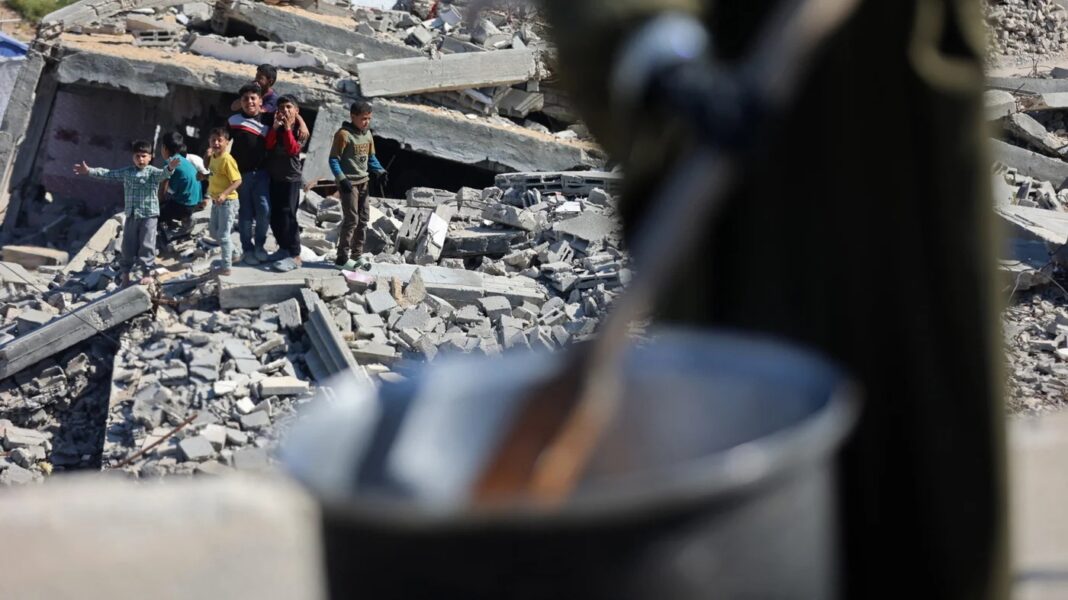

World Central Kitchen (WCK), the biggest supplier of hot meals in Gaza, has reduced its daily food distribution by 50 percent, lowering output from around one million meals to 500,000. The organisation announced the cuts on Thursday, citing surging food and fuel costs driven by the economic fallout of the US-Israeli war on Iran, which began in February. The reduction leaves hundreds of thousands of Palestinians — already almost entirely dependent on aid to survive — with fewer meals at the worst possible time.
In an essay published in Semafor, WCK founder José Andrés said the US-Israeli war in Iran has pushed up the cost of rice by 30 percent, while chicken and meat prices have spiked between 10 and 20 percent. Gas prices have also soared. Together, these cost increases have made it financially impossible for the organisation to sustain the operational pace it reached just three months ago.
“We specialise in emergency food relief, not long-term food security,” WCK said in a statement. “The long-term responsibility of feeding Gaza cannot rest on the shoulders of one organisation alone.”
The organisation also called on governments and international institutions to act. “The people of Gaza have lost their homes and their economy,” WCK said. “The world must step up — not just talk about the plight of the Palestinians. Governments, institutions and international partners need to commit the sustained, secure funding that this crisis demands.”
On its website, WCK acknowledged that financial sustainability has become as significant a challenge as operational access, and that the difficulties it faces have been compounded by rising food and fuel costs driven by the conflict in Iran. The organisation noted it is funded overwhelmingly by private donations and cannot sustain its effort indefinitely without broader institutional support.
Families Protest in Gaza
Displaced families responded to the cuts by banging empty pots and pans at protest gatherings, voicing fears of a return to starvation. The scenes unfolded at schools converted into shelters for displaced Palestinians across the territory.
Amna Ormana, a mother who attended one such rally, said she did not know how her family would get by. “We don’t know how we will get by or how we will feed our kids,” she told NPR’s Anas Baba in Gaza.
Her situation reflects a broader collapse. The United Nations has warned that its agencies are also facing funding shortages and rising costs, while one in five people in Gaza is now surviving on just one meal a day.
A Crisis Built on Multiple Pressures
WCK’s operational retreat is not an isolated event. It is the product of compounding pressures: an Israeli blockade, continued military operations, a damaged local economy, and now the economic shockwaves of a regional war spreading beyond Gaza’s borders.
Earlier in May, WCK said that “financial pressure” was already forcing it to scale back operations. The formal 50 percent cut announced this week represents an acceleration of that trend.
Whether other aid organisations can absorb the shortfall remains unclear. It is unclear if other aid groups can fill the gap. No organisation has yet announced plans to compensate for the reduction in WCK meals.
Regional and Global Impact
The cuts expose a structural vulnerability in Gaza’s humanitarian architecture: the enclave’s food supply has become dependent on a single large provider operating in increasingly hostile economic conditions. The reduction threatens Palestinians already pushed to the edge by Israel’s assault and blockade, with Gaza’s population almost entirely dependent on aid to survive.
For the broader region, the episode demonstrates how the Iran conflict is producing downstream consequences well beyond the battlefield — reshaping commodity prices, logistics costs, and the operational capacity of non-governmental organisations working in conflict zones across the Middle East.
The United Nations has also warned that the situation in Gaza remains highly fragile without sustained and expanded access to aid.
Background
Gaza has been under Israeli attack and blockade since October 2023, and the enclave’s food sources and economy have been largely destroyed over more than two years of conflict. A US-backed ceasefire announced in October was intended to halt the war and lift the siege, allowing flows of aid, food, and medicine into the territory. However, Israel has consistently breached the agreement and largely maintained the blockade, keeping fuel, food, and medical supplies critically scarce. More than 800 people have been killed since the ceasefire began, and overall, Israeli forces have killed more than 72,700 people since October 2023, with more than 172,000 others wounded. middleeasteye
WCK had reached a peak of one million meals per day — enough to cover approximately half of Gaza’s population — before this week’s cuts.
What Happens Next
WCK has stated it will continue distributing hundreds of thousands of meals daily and has not revealed a timeline for restoring earlier output levels. The organisation has formally called on governments and international institutions to commit sustained funding to Gaza’s food relief operations. The United Nations has not confirmed whether its agencies will increase operations to compensate for WCK’s reduction. No other major aid organisation has publicly announced plans to fill the gap left by the cuts. WCK said it would maintain what it described as one of the largest food relief operations in the world, but at a reduced level.