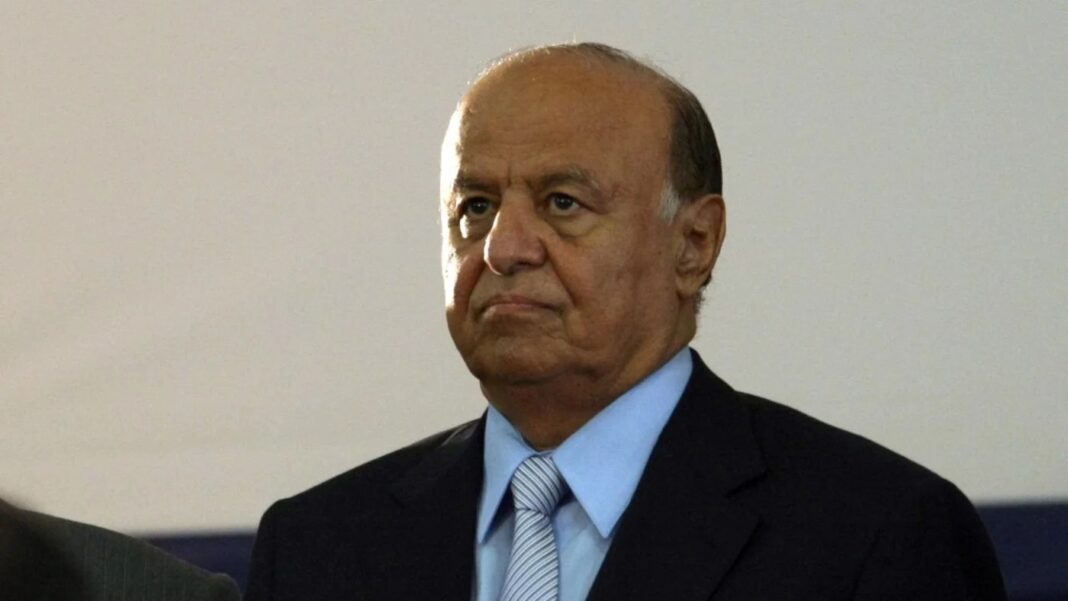

Abd Rabbuh Mansour Hadi, the internationally recognised president of Yemen who led a fractured government mostly from exile for eight years as the country descended into civil war and famine before stepping down in 2022, died on Thursday. He was 80. State-run Yemeni TV said that he died at his residence in Riyadh, the capital of Saudi Arabia, but gave no other details.
Sources in the Yemeni presidency told AFP that Hadi “died in the Saudi capital following a sudden health crisis.”
Rashad al-Alimi, the head of the Presidential Leadership Council — the leadership body of Yemen’s internationally recognised government — said Hadi believed in the Yemeni people’s “right to a just state, freedom and human dignity.” “He led the battle to defend the republican system,” al-Alimi said on X.
Sources told Arab media that Hadi will be buried on Friday in Riyadh.
Former Yemeni Foreign Minister Abdulmalik al-Mekhlafi, who worked under Hadi, issued his condolences on social media and said he had been unfairly treated in life. “I believe that the man was not given his due justice as he deserved, neither during his period of rule nor even before it, as an image was formed around him in the media that was often far from his true reality,” he wrote on X.
Palestinian Authority President Mahmoud Abbas sent a cable of condolences to Rashad al-Alimi, Chairman of the Presidential Leadership Council of the Republic of Yemen, on the death of the former president.
The Houthis had not officially commented on Hadi’s death, though one spokesperson acknowledged he had died in “mysterious circumstances.”
Hadi’s death closes the chapter on one of the most turbulent presidencies in Yemen’s modern history — a tenure defined by exile, armed conflict, and a prolonged humanitarian emergency that outlasted his time in office.
Hadi became president in 2012 after the resignation of longtime leader Ali Abdullah Saleh during the Arab Spring uprisings. Backed by the United States and Gulf states, Hadi emerged as a compromise candidate in a one-person election meant to guide Yemen through a political transition. But his presidency soon got bogged down in unrest.
During his first years in office, Hadi tried to implement wide-reaching reforms, including the unification of the country’s various armed factions. His opponents accused him of favouring the country’s eastern oil-rich provinces at the expense of the mountainous heartlands dominated by the Houthis, the Iran-aligned movement.
Increasing tensions with Ansar Allah — better known as the Houthis — eventually led to the group seizing the capital Sana’a, Hadi fleeing into exile, and Saudi Arabia launching an offensive in Yemen. Hadi had been living in Saudi Arabia since 2015 when he fled following the outbreak of conflict between his Saudi-backed government and the Houthi movement.
He resigned as president in 2022 and had reportedly been living in virtual house arrest in the Saudi capital ever since. By the time he stepped down — handing power to a Presidential Leadership Council — the conflict in Yemen had left hundreds of thousands dead and plunged the country into a humanitarian crisis.
Background
Abdrabbuh Mansour Hadi was born in 1945 in the village of Dhiqin in the Al-Wadea district of Abyan governorate. Born when South Yemen was still a British protectorate, Hadi occupied a number of military and political roles in both the Marxist-Leninist People’s Democratic Republic of Yemen and the northern Yemen Arab Republic until the country was unified in 1990. He served as vice president of Yemen under Ali Abdullah Saleh between 1994 and 2012, when he took over as president following Saleh’s ouster by the Arab Spring protests. Another challenge during his presidency came from al-Qaida in the Arabian Peninsula, long considered one of the global network’s most dangerous branches. The group carried out a bombing in Sana’a in 2012 that killed more than 100 people.
Regional Impact
Hadi’s death carries symbolic weight but is unlikely to alter the immediate political landscape in Yemen. The Presidential Leadership Council, which al-Alimi chairs, has been the internationally recognised governing body since Hadi transferred power in April 2022. Yemen’s war continues, with the Houthis retaining control of Sana’a and large parts of the country’s north. Hadi was regarded as one of the most prominent figures linked to the most complex political and military transitions in Yemen’s modern history, particularly during the post-Arab Spring period, the rise of the Houthis, and the outbreak of the war that reshaped the Yemeni landscape.
What Happens Next
Hadi is expected to be buried in Riyadh on Friday. The Presidential Leadership Council, now the formal authority of Yemen’s recognised government, is expected to lead official mourning proceedings. No succession process is triggered by Hadi’s death, as he had already transferred all presidential powers to the Council in 2022. The Houthi movement has yet to issue a formal statement, and the broader trajectory of peace negotiations in Yemen is not expected to change as a direct result of his passing.