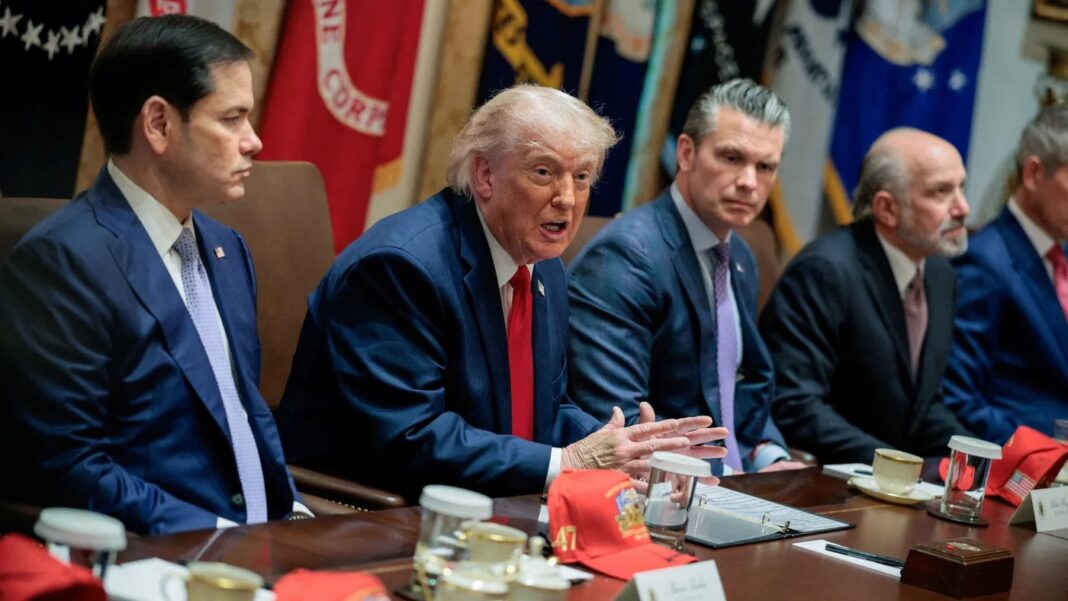

U.S. President Donald Trump declared on Wednesday that lifting sanctions on Iran is not under consideration in ongoing negotiations aimed at ending the war, reopening the Strait of Hormuz, and reducing Iran’s nuclear capabilities. The statement, made during a cabinet meeting at the White House in Washington, DC, deepens a fundamental gap between the two sides as talks continue. Tehran has made financial relief its primary objective in any prospective agreement.
The announcement comes as Iranian leaders push hard for access to frozen funds. Iranian parliamentary speaker Mohammad Bagher Ghalibaf has repeatedly insisted that unlocking access to his country’s money should be a confidence-building measure, if not a precondition, for talks with the United States.
Both Ghalibaf and Iran’s central bank chief travelled to Qatar on Monday to discuss the release of approximately $6 billion held in the Gulf state — on Washington’s orders — since September 2023, signalling a potential breakthrough.
Talks Stall Over Sanctions Gap
Trump told reporters he remains unsatisfied with the current state of negotiations. Secretary of State Marco Rubio, who attended the cabinet meeting, told reporters: “I think there’s been some progress and some interest, and we’ll see over the next few hours and days whether progress could be made.” He added: “The bottom line is Iran’s never going to have a nuclear weapon.”
The two sides appear far apart on the terms of any deal. Iran maintains it is owed up to $120 billion of its own revenue that has been withheld by foreign governments and banking institutions under U.S. sanctions steadily imposed since the 1979 Islamic Revolution.
Ali Vaez, project director on Iran at the International Crisis Group, said Tehran views the conflict through a different lens than Washington. “Survival is victory. They have managed to repel an aggression by the mightiest military power in the world, that of the United States, and also the mightiest intelligence service in the world, that of Israel,” he told reporters. Vaez added that Iran had gained a new tool of deterrence in the form of its control over the Strait of Hormuz — a leverage point it had not previously deployed.
Hormuz and the Oman Warning
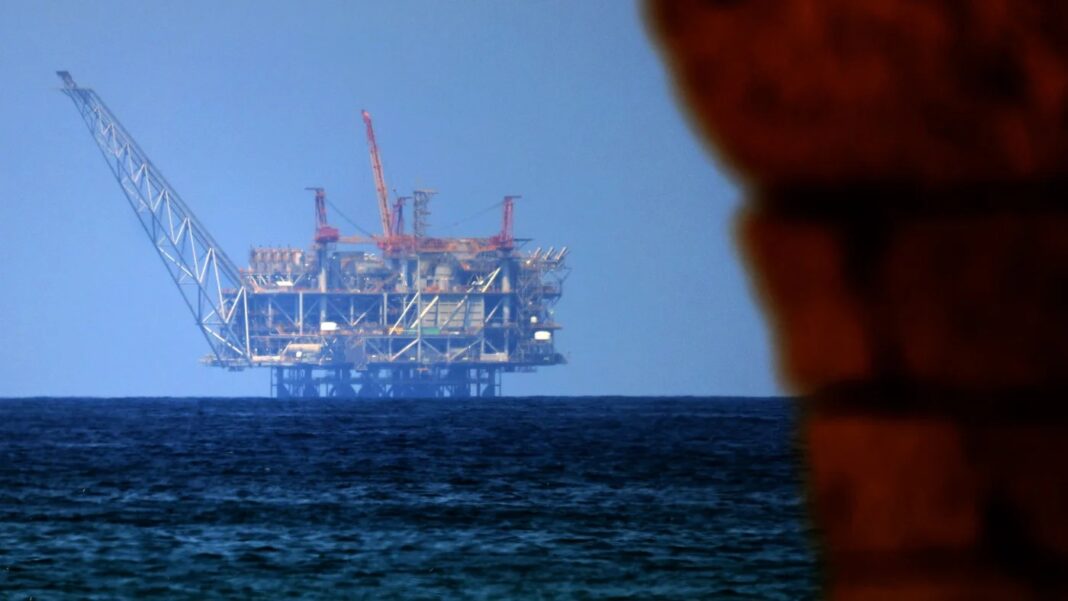
Trump has also drawn a firm line on the Strait of Hormuz, the critical waterway first blocked by Iran to halt U.S. and Israeli-linked vessels and later counter-blocked by the U.S. Navy to prevent Iranian oil exports. “The strait is going to be open to everybody,” Trump said.
Trump went further on Wednesday, issuing a pointed warning to Oman. Trump said he would “blow up” Oman if it agreed to work with Iran to impose a fee for ships transiting the Strait of Hormuz as part of a settlement to end the U.S.-Israeli war on Iran. “Oman will behave just like everybody else, or we’ll have to blow them up,” he said.
Iran Claims Draft Framework; White House Denies It
Earlier on Wednesday, Iranian state TV reported that Tehran had received an unofficial draft framework for a memorandum of understanding with Washington. Under the reported terms, Washington would withdraw its military forces from the vicinity and lift its naval blockade if Tehran restored commercial transit through the Strait of Hormuz to pre-war levels within one month.
Iranian state TV reported that traffic management and shipping routes would be overseen by Iran in coordination with Oman, and that if a final agreement were reached within 60 days, it would be approved through a binding United Nations Security Council resolution.
Ali Bagheri Kani, deputy secretary of Iran’s Supreme National Security Council, said in comments carried by Iran’s Mehr news agency that “the conditions and procedures for passing through the Strait of Hormuz will be completely different from the conditions before the conflict over Iran began.”
The White House moved swiftly to deny the report, calling the described draft a “complete fabrication.”
Israel Opposes Any Agreement
Israel has made its position clear. Danny Citrinowicz, senior researcher at the Institute for National Security Studies, said at a discussion panel: “Israel, I think, is really hoping for no agreement. The last thing that Israel wants to see is an agreement between the US and Iran.”
Vaez of the International Crisis Group said any longer-term non-aggression pact between Washington and Tehran would likely need to address Lebanon. “It’s very hard for the Iranians to throw Lebanon under the bus,” he said, referring to Iran’s ally Hezbollah. “So, at this point, including the conflict with Lebanon is important for the Iranians.”
Background
The 1996 Iran Sanctions Act expanded sanctions to those doing business with Tehran and barred it from obtaining a nuclear weapon. From 2005 onwards, a series of U.S. sanctions were imposed on individuals and companies alleged to have ties to terrorist activity. U.S. sanctions not only prevent American nationals and residents from doing business in Iran, but also deny Iran access to the U.S.-dominated global banking system, which runs largely on dollars and utilises U.S. transfer mechanisms such as Swift. The U.S.-Israeli war on Iran began on 28 February 2026. A Pakistan-brokered ceasefire is currently in effect, though on Monday the U.S. carried out what it described as “self-defence” strikes on Iranian missile sites despite that agreement.
What Happens Next
Concerns have been raised about whether American forces would have enough firepower in a future conflict with China, given heavy use of key U.S. weapons systems during the war on Iran. The Center for Strategic and International Studies, in a report released on Wednesday that also examined Trump’s proposed $1.5 trillion defence budget for 2027, said that “the depleted inventories have created a window of vulnerability for a potential Western Pacific conflict,” adding: “The problem today isn’t money; it’s time.” Negotiations are expected to continue over the coming days, with Secretary of State Rubio indicating that progress — or its absence — will become clear within hours. Any deal involving the Strait of Hormuz would require Iranian compliance within a one-month window under the framework Iran described, though the White House has denied that framework exists.