
Russian-installed authorities in occupied Crimea and Sevastopol suspended all civilian fuel sales on Sunday, June 21, after Ukrainian drone strikes hit oil terminals near the city of Kerch. The Russia-appointed governor of Crimea, Sergey Aksyonov, said gas stations would stop selling fuel to individuals and businesses for an undefined period. Russian-installed Sevastopol governor Mikhail Razvozhayev confirmed a similar suspension hours later, citing logistical disruptions.
Aksyonov said fuel would now be reserved exclusively for state operations. “Fuel will be sold only to government agencies that ensure the functioning and security of the Republic of Crimea,” he wrote on social media, according to Business Standard. He added, “I ask everyone to remain calm and to only trust official sources of information.”
The suspension followed an overnight drone attack that struck an oil depot in Kerch and ignited a large fire at a fuel terminal, according to the Ukrainian outlet The New Voice of Ukraine. The Telegram channel Krymskyi Veter reported that the blaze showed no signs of subsiding and produced a smoke plume stretching dozens of kilometers. Aksyonov said the strike killed four people and injured 28 others.
Ukrainian President Volodymyr Zelensky confirmed his forces carried out the operation. He said Ukraine had hit “targets on both sides of the Crimean Bridge,” including maritime logistics used for oil transportation in Russia’s Krasnodar region and the oil depot in Kerch, according to Yahoo News Canada. Zelensky described the strikes as a “just response to Russia’s brutal attacks.”
Local authorities in Russia’s Krasnodar region, which lies across the Kerch Strait from Crimea, reported that a separate drone strike sparked a fire at a Black Sea oil terminal in the village of Chushka. One person was killed when an attack struck a passenger ferry, regional officials said. The Krasnodar Krai operational headquarters also announced the suspension of ferry services across the Kerch Strait, instructing truck drivers headed to Crimea to use a land route instead.
Zelensky said Ukrainian forces also struck military logistics facilities and radar systems during the operation, without specifying their locations.
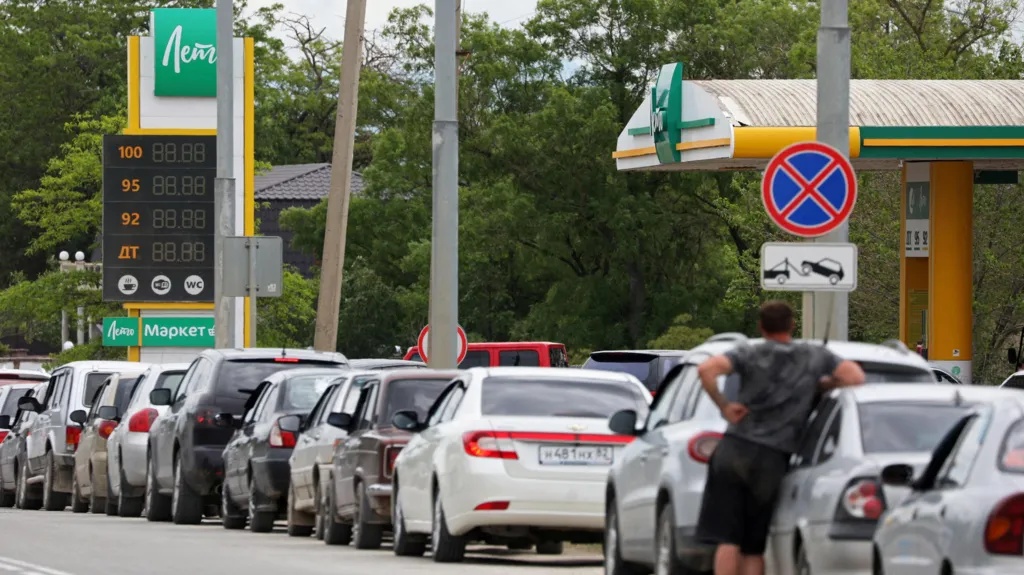
Sunday’s suspension was not the first fuel restriction imposed on the peninsula. Aksyonov introduced a cap of 20 liters of gasoline per person per week at the end of May, distributed through prepaid coupons, according to Business Standard. Those vouchers were claimed almost immediately after release on an official messaging channel, prompting long lines at gas stations. Some residents have driven into Crimea with their own fuel from Krasnodar via the Kerch Bridge, though they are limited to carrying 100 liters per vehicle.
An analyst at the French research institute Atum Mundi, Clément Molin, told the BBC that the supply route across the Kerch Bridge functions as the “backbone” of Russian occupation forces in southern Ukraine. He estimated that Ukraine has carried out roughly 300 drone strikes against trucks using the route since early May, including 30 strikes on fuel tankers. The Ukrainian military estimates traffic on the route fell by more than 70% between late May and early June, according to Molin’s analysis cited by the BBC.
Regional Impact
Crimea, annexed by Russia in 2014, is now experiencing its most severe fuel shortage since the annexation, according to Business Standard. The peninsula serves as a key staging area for Russian military operations in southern Ukraine, making fuel access a direct factor in supply lines to occupied territory. The disruption has also reached Krasnodar, a major Russian tourist region, where a local tourism corporation reported that sales had fallen between 20% and 30% compared with the same period last year.
Kyiv has framed the campaign as targeting the infrastructure that supports Russia’s war effort rather than civilian life directly. Zelensky said in a statement that Ukraine’s strikes represent “long-range sanctions” against Russia’s energy infrastructure, adding, “Russia understands only strength, and our long-range strength is certainly working for peace,” according to Business Standard.
Background
Ukraine has expanded its drone campaign against Russian oil infrastructure since early 2025, targeting refineries, storage terminals and fuel convoys far beyond the front line. Zelensky said last month that 40% of Russia’s core refining capacity had been taken offline by the strikes, according to the BBC. Harvard University researcher Craig Kennedy, who studies Russia’s oil sector, told the BBC that Kyiv’s campaign has widened to include smaller refineries, producing effects felt more directly by ordinary Russians. Crimea has faced periodic fuel shortages from Ukrainian strikes before, but officials and residents describe the current crisis as the worst since the 2014 annexation. Russia has continued large-scale strikes on Ukrainian cities throughout the same period, which have also caused civilian casualties.
What Happens Next
Russian-installed authorities in Crimea and Sevastopol have not specified when civilian fuel sales will resume. The Krasnodar Krai operational headquarters has directed freight traffic toward an alternate land corridor while ferry services across the Kerch Strait remain suspended. Firefighting operations were continuing at the Kerch terminal as of Sunday, with local monitors reporting no sign the blaze was contained. Ukrainian officials have not indicated whether further strikes on the corridor are planned, though Kyiv has continued targeting Russian energy infrastructure on a near-weekly basis in recent months.