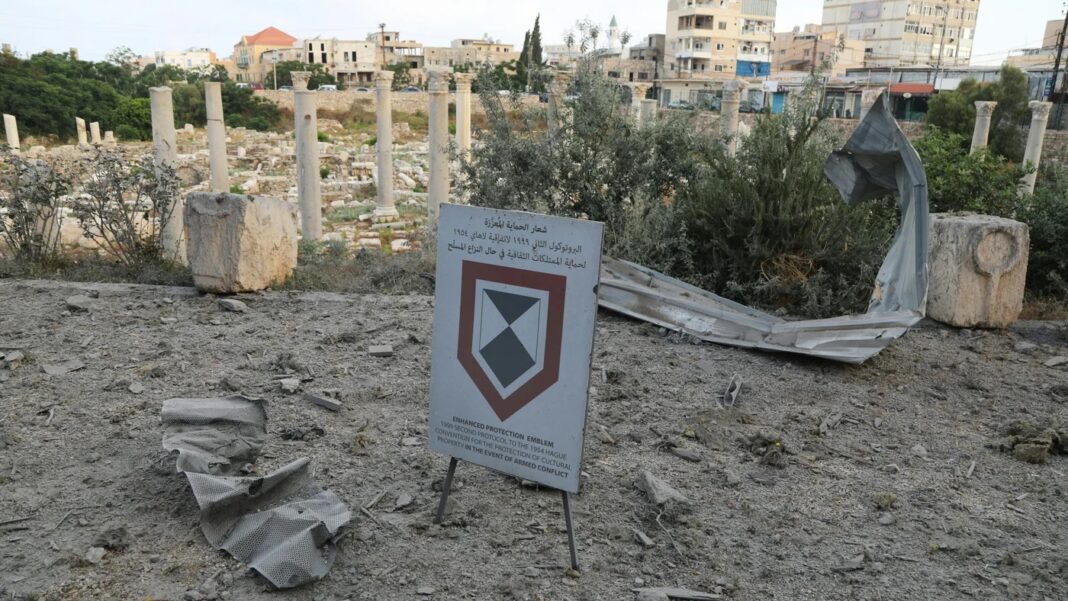

Israeli forces intensified bombardment of the southern Lebanese city of Tyre on Sunday, June 7, striking near the city’s UNESCO-listed Roman and Phoenician ruins, according to Arab News. Lebanon’s Directorate General of Antiquities confirmed that the Tyre maritime archaeological site was bombed that day, with land-based heritage sites struck the following day. The strikes come amid an Israeli military campaign across southern Lebanon that has displaced roughly 200,000 people from Tyre and the surrounding area, according to Al Jazeera.
Sarkis Khoury, director general of Lebanon’s Directorate General of Antiquities, told Arab News that Israel had ignored the protective measures Lebanon placed on its heritage sites. “We raised blue shields over every site classified by UNESCO, yet they failed to keep Israeli warplanes and artillery at bay,” Khoury said. He added that the damage was not limited to direct hits. “We have observed the shifting of capitals on Roman columns from their original positions,” he said, noting that preliminary assessments suggest some structures could face gradual deterioration leading to partial collapse.
Lebanon’s Ministry of Culture said in a statement reported by Arab News that any strike on the Tyre site, or any attempt to justify exposing it to damage, would breach international agreements protecting cultural property during armed conflict. Of the 73 heritage sites on Lebanon’s protected list, Khoury said most lie in the south, stretching from Sidon to Naqoura and into border villages, including the ruins of Tyre and the castles of Tibnin, Beaufort and Chamaa.
Tyre, located roughly 83 kilometers south of Beirut, contains remains from one of the most important cities of the ancient Phoenician world, including extensive Roman-era ruins and one of the largest hippodromes built by the Roman Empire, according to Al Jazeera. The city has been continuously inhabited for nearly 5,000 years. Strikes on the area had first resumed on March 2 after an earlier round of bombardment between October 2023 and November 2024, according to ArchDaily. On May 30, Israel issued a mass evacuation order for Tyre, displacing an estimated 160,000 people and striking sites under UNESCO protection, ArchDaily reported.
Beaufort Castle, a 900-year-old fortress that UNESCO describes as one of the best-preserved medieval castles in the Near East, was seized by Israeli forces on May 30, according to ArchDaily. Israel had previously captured and held the same site from 1982 to 2000. The castle lies near the southern city of Nabatieh, an area that has seen some of the heaviest fighting in the current campaign.
The destruction extends beyond individual monuments. According to ArchDaily, satellite imagery has confirmed that more than two dozen Lebanese border towns and villages have been razed since March 2026. The town of Bint Jbeil has lost more than 70 percent of its built area, with another 20 percent partially damaged, the town’s mayor told ArchDaily.
UNESCO has been coordinating with Lebanon’s Ministry of Culture and Directorate General of Antiquities to secure archaeological collections and museum holdings, and is using satellite monitoring through UNITAR/UNOSAT to track damage to protected sites, according to ArchDaily. The agency issued a statement of solidarity with Lebanon in April pledging support for the eventual recovery of damaged sites. Despite that coordination, strikes on and around protected sites have continued.
A separate conflict has caused comparable damage to heritage sites in Iran. Strikes by the United States and Israel that began in late February have damaged at least six heritage sites in the country, according to the Irish Times. In the city of Isfahan, air strikes in March damaged the Chehel Sotoun Palace, a 17th-century Safavid structure where windows were shattered and frescoes dating to around 1650 sustained damage, the Irish Times reported. The nearby Masjed-e Jameh mosque, Iran’s oldest Friday communal prayer mosque, suffered damage when ornate tiles collapsed in its arcades.
Isfahan governor Mehdi Jamalinejad said the attacks amounted to an assault on cultural identity. “This is a declaration of war on a civilisation,” Jamalinejad said, according to the Guardian. “An enemy that has no culture pays no heed to symbols of culture. A country that has no history has no respect for signs of history.” In a separate social media statement reported by the New Arab, Jamalinejad said blue shield markings — signals recognized under the 1954 Hague Convention for the Protection of Cultural Property — had been placed on the roofs of historic buildings before the strikes occurred.
In Tehran, the Golestan Palace, a 19th-century UNESCO-listed complex built under the Qajar dynasty, sustained damage from shockwaves after a strike on nearby Arak Square on March 2, according to artnet News. The palace’s Hall of Mirrors suffered the worst damage, with its decorative mosaics shattered, though artifacts including chandeliers had already been moved to secure storage before the strikes, artnet News reported. UNESCO said it had communicated the coordinates of World Heritage sites in Iran “to all parties concerned” but expressed concern over the damage sustained regardless.
Sussan Babaie, a professor in the arts of Iran and Islam at the Courtauld Institute of Art in London, said the pattern of destruction extended well beyond any single city. “Cities and civilians are targets of vast destruction and historical monuments appear to be indiscriminately destroyed or damaged,” Babaie said, according to artnet News. She noted that Iran has 26 UNESCO-designated heritage sites, which she described as testimony to the depth of civilization on the Iranian plateau.
The US Committee of the Blue Shield, an organization focused on protecting cultural property during armed conflict, said in a statement cited by the New Arab that Iran’s heritage “belongs not only to the Iranian people, but to all of humanity.” The group’s statement referenced damage near the Khorramabad Valley UNESCO site, which contains prehistoric caves with evidence of human occupation dating back roughly 63,000 years, and to Falak-ol-Aflak Castle in Lorestan province, which Iranian sources said was struck at its perimeter, according to the New Arab.
For Lebanon, officials say the damage threatens both physical structures and the country’s broader claim to its cultural identity. Khoury told Arab News that the pattern of strikes amounted to “a cultural war aimed at erasing Lebanon’s connection to its roots.” For Iran, the loss centers on monuments tied to the Safavid and Qajar periods that predate the modern Iranian state by centuries, with officials and heritage bodies warning that the damage cannot be easily reversed.
The conflicts driving the destruction in both countries remain active. In Lebanon, Israeli strikes and Hezbollah attacks on Israeli troops in the south were both reported as ongoing as of mid-June, according to Arab News. In Iran, strikes by the US and Israel that began February 28 have continued for months, with Iranian forces also launching strikes in response, according to artnet News.
UNESCO has continued satellite monitoring of both countries’ heritage sites and has pledged support for eventual restoration once hostilities end. Lebanese and Iranian officials have called for international intervention to halt strikes near protected sites, though no ceasefire affecting either country’s heritage zones had been formally announced as of this report. Lebanon’s Ministry of Culture said it would continue to monitor damage to archaeological and historical sites on a daily basis.