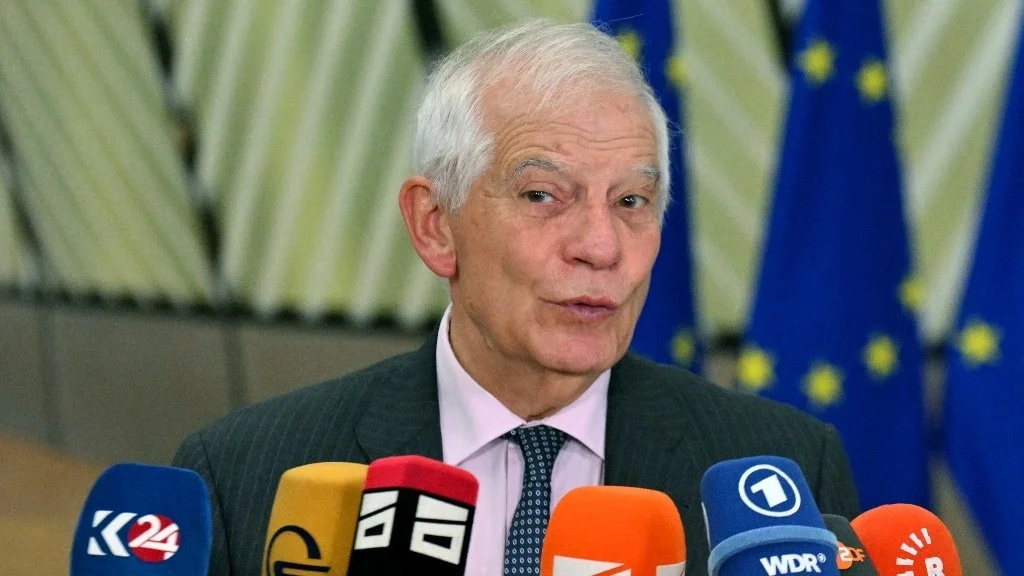

Former European Commission Vice President Josep Borrell accused the European Union on Wednesday of abandoning his successor, Kaja Kallas, after Israel suspended diplomatic contact with her. Borrell made the accusation on social media platform X, pointing to a visit by another EU commissioner to Tel Aviv the day after the rift became public. The dispute stems from a report that Kallas privately compared Israel’s conduct toward Palestinians to apartheid-era South Africa.
Israeli Foreign Minister Gideon Saar announced last week that he was suspending contact with Kallas, the EU’s High Representative for Foreign Affairs and Security Policy, after the comparison surfaced. The report originated from Euractiv, which said officials and diplomats present at the meeting described Kallas drawing the comparison during confidential talks with Mexican officials in Mexico City.
According to Euractiv, Kallas travelled to Mexico City as part of a senior EU delegation from May 20 to May 22. During those talks, sources told the outlet, she referenced a visit she made the previous year to South Africa’s apartheid museum in Johannesburg. She is reported to have linked Israel’s rule over Palestinians in Gaza and the occupied West Bank to South Africa’s system of racial segregation, which lasted from 1948 until the early 1990s, according to Euractiv’s sourcing.
Borrell’s criticism focused on the EU’s response once the row became public. He noted that Dubravka Suica, the European commissioner for the Mediterranean and for demography, travelled to Tel Aviv the day after Israel declared Kallas unwelcome over the alleged remarks. Borrell wrote on X that Suica’s meeting with Saar involved a warm exchange and no criticism of Israel’s position, which he characterized sarcastically as a poor display of coordination within the EU.
“What a fine display of ‘solidarity and coordination’ in the EU,” Borrell wrote, referring to the contrast between Suica’s reception in Tel Aviv and the treatment of Kallas.
The episode has drawn attention to what critics describe as inconsistency in Kallas’s own record on international law. She has taken a firm position on Russia’s invasion of Ukraine and pushed for extensive sanctions against Moscow, according to Middle East Eye. On Israel, however, she has repeatedly defended what she calls the country’s right to self-defense, even as Palestinians in Gaza face bombardment, siege and displacement, the outlet reported.
Progressive members of the European Parliament have separately criticized the EU’s overall response to the war in Gaza, describing it as weak when measured against the bloc’s posture toward Russia. Those lawmakers have called for tougher sanctions on Israel, a suspension of the EU-Israel Association Agreement and an end to what they describe as political cover for Israeli policy, according to Middle East Eye.
Regional and global impact
The dispute exposes friction within the EU’s foreign policy apparatus over how to handle Israel at a moment when Kallas, the bloc’s top diplomat, finds herself at odds with one of the EU’s key Middle Eastern partners. Israel’s decision to suspend contact with Kallas removes a direct diplomatic channel between Jerusalem and Brussels’ foreign policy chief at a time when the EU is attempting to coordinate a unified position on Gaza. Borrell’s public criticism suggests the rift extends beyond Israel and the EU’s external relations into internal divisions among European officials over how member states and commissioners should respond.
Background
Kallas has served as the EU’s High Representative for Foreign Affairs and Security Policy since December 2024, succeeding Borrell in the role. She has built a reputation as one of Europe’s most outspoken critics of Russia, having previously served as prime minister of Estonia. Her public statements on Israel have generally emphasized the country’s right to self-defense, a position that has drawn criticism from EU lawmakers who argue it conflicts with her hardline stance on Russia. Saar’s decision to suspend contact followed the publication of the Euractiv report detailing her reported private remarks in Mexico City. The EU has not issued a unified public response addressing the suspension of contact between Saar and Kallas.
What happens next
Neither the European Commission nor Kallas’s office has issued a public statement responding to Borrell’s accusation, according to Middle East Eye’s report. Saar’s suspension of contact with Kallas remains in effect, with no indication from Israeli officials of a timeline for resuming direct communication. The EU has not announced any change to its diplomatic engagement with Israel following Suica’s visit to Tel Aviv. Further developments are expected to depend on whether Kallas or the European Commission directly addresses the apartheid comparison reported by Euractiv.