
Three Pakistani Rangers Killed as Militants Storm Paramilitary Headquarters in Karachi
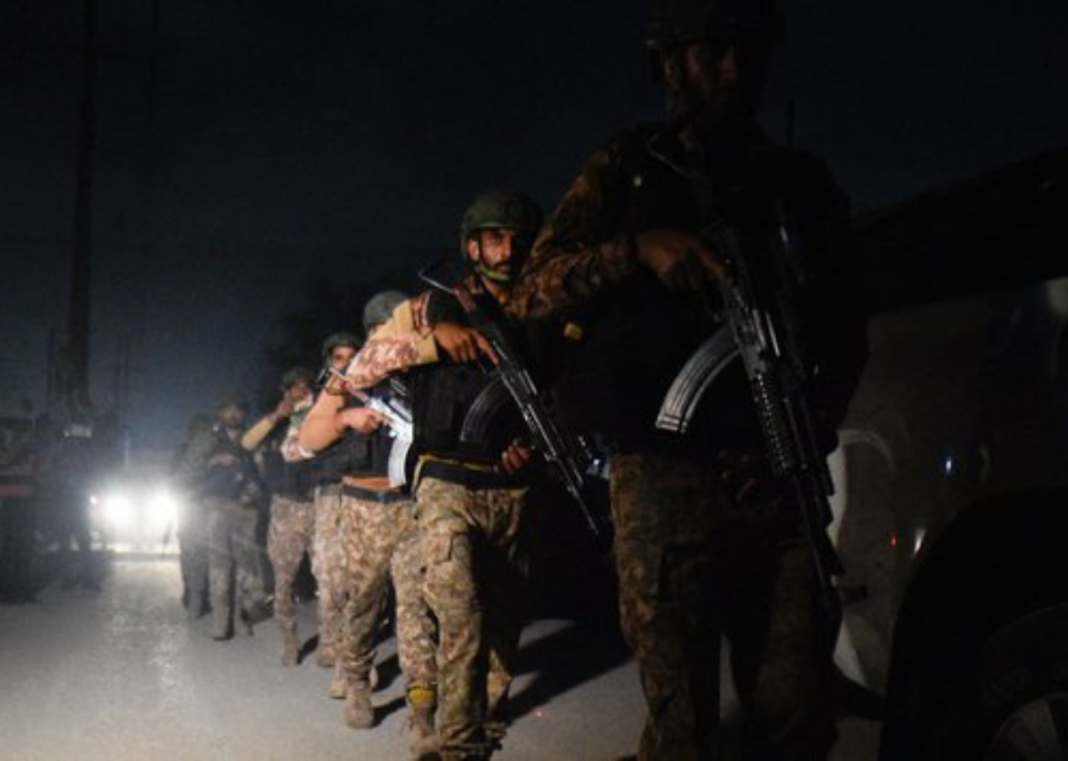
At least three of Pakistan’s Sindh Rangers personnel were killed on Saturday, June 27, in an attack on the paramilitary forces headquarters in Karachi, the Dawn newspaper reported, in the most notable assault on the southern port city in nearly two years. Three militants were also killed in the attack, Sindh Inspector General Javed Alam Odho told Dawn.
An explosion and gunfire were reported on a major road in Karachi’s Gulistan-i-Jauhar neighbourhood, near several universities and Pakistan’s meteorological department. Witnesses said a militant rammed an explosives-laden vehicle into the provincial headquarters of the paramilitary force, triggering an intense exchange of gunfire with security personnel.
Mohammad Bakhsh, a 40-year-old who runs a restaurant in the area, said he was praying at a nearby mosque when he heard the blast. “The ground was shaking like during an earthquake,” he said. “When we came out there was smoke everywhere.”
A Reuters reporter at the scene said firing had ended and the situation was calm by the time of reporting.
The City’s Worst Attack in Nearly Two Years
This is the most notable attack in Karachi since an explosion targeting a Chinese convoy in October 2024, which killed two Chinese nationals. Attacks in Pakistan’s major cities have become increasingly rare in recent years, even as a sustained surge in militancy in regions bordering Afghanistan has raised concerns that violence could spread back into the country’s urban centres.
A Rangers Force Built for This Mission
The Sindh Rangers are a federal paramilitary force that has played the lead role in Karachi’s counterterrorism and security operations since being granted expanded policing authority under Pakistan’s 2015 National Action Plan, introduced after a 2014 Taliban attack on an army school in Peshawar killed more than 130 children. That mandate has been credited by security analysts with the substantial decline in militant and criminal violence the city experienced over the following decade, making Saturday’s direct assault on Rangers headquarters a symbolically significant break from that pattern.
The Wider Security Backdrop
Saturday’s attack lands amid the most severe deterioration in Pakistan’s domestic security environment in over a decade. According to the Pakistan Institute for Conflict and Security Studies, 2025 was the deadliest year on record for the country’s long-running confrontation with militant and insurgent groups, with 2,115 militants and insurgents killed nationwide alongside 664 security personnel and 580 civilians. The Centre for Research and Security Studies recorded a 34 percent rise in militant violence in 2025 alone, continuing a trend of near-uninterrupted annual increases since the Afghan Taliban returned to power in Kabul in 2021.
That deterioration culminated in an unprecedented escalation earlier this year. Pakistan declared what it called an “open war” against Afghanistan in late February 2026 after carrying out airstrikes on militant camps inside Afghan territory, accusing the Taliban government of harbouring Tehrik-i-Taliban Pakistan (TTP) fighters responsible for a wave of attacks inside Pakistan. The strikes triggered a broader cross-border confrontation involving artillery exchanges, drone incidents, and clashes at multiple points along the frontier, in the most direct military confrontation between the two governments since the Taliban’s return to power. More than 3,500 Pakistani security personnel and civilians have been killed in TTP attacks since 2021, according to the International Crisis Group.
While the bulk of recent militant violence has been concentrated in the frontier provinces of Khyber Pakhtunkhwa and Balochistan — the latter the site of a wave of coordinated attacks across nine districts in January 2026 that the Pakistan Institute for Peace Studies described as among the deadliest in the province’s history — Saturday’s attack on a major paramilitary installation in Karachi signals the kind of spread into Pakistan’s urban mainland that security analysts have warned could follow if the frontier conflict remained unresolved.
Regional and Global Impact
The attack on a city as economically significant as Karachi, Pakistan’s largest city and primary commercial port, carries implications beyond its immediate casualty toll. Karachi handles the bulk of Pakistan’s seaborne trade and hosts a substantial concentration of foreign commercial and diplomatic interests, including Chinese nationals working on projects linked to the China-Pakistan Economic Corridor — a dynamic underscored by the fact that the city’s previous most serious attack, in October 2024, specifically targeted a Chinese convoy. Any sustained return of militant violence to Karachi would raise fresh concerns among foreign governments and investors about the security of personnel and infrastructure in the city.
For Pakistan’s government and security establishment, the attack adds further pressure at a moment when the broader counter-militancy campaign — spanning cross-border operations against Afghanistan, sustained operations in Balochistan against separatist insurgents, and operations against the TTP in Khyber Pakhtunkhwa — has yet to produce a durable reduction in nationwide violence, despite mounting military and civilian casualties.
Background
Pakistan has battled a sustained insurgency along its border with Afghanistan since the Tehrik-i-Taliban Pakistan, an umbrella militant organisation allied with al-Qaeda, was driven into Afghan territory following a major Pakistani military offensive in 2014. The group’s strength has grown steadily since the Afghan Taliban retook power in Kabul in 2021, with Pakistani officials accusing Kabul of providing sanctuary to TTP fighters — an allegation the Taliban government has consistently denied. The Sindh Rangers have operated in Karachi since before 2015 but were granted significantly expanded counterterrorism authority that year, following the Peshawar school attack, contributing to a marked decline in the city’s militant and criminal violence over the following decade.
What Happens Next
Pakistani security officials are expected to investigate the attack further and identify the group responsible, with authorities likely to assess whether it represents an isolated incident or a deliberate signal of intent to expand militant operations into Pakistan’s major urban centres. The attack is likely to intensify scrutiny of the broader counter-militancy campaign Pakistan has pursued against both the TTP along the Afghan border and separatist insurgents in Balochistan, with analysts having previously warned that mounting security personnel losses could eventually force more decisive military or political action from Islamabad.