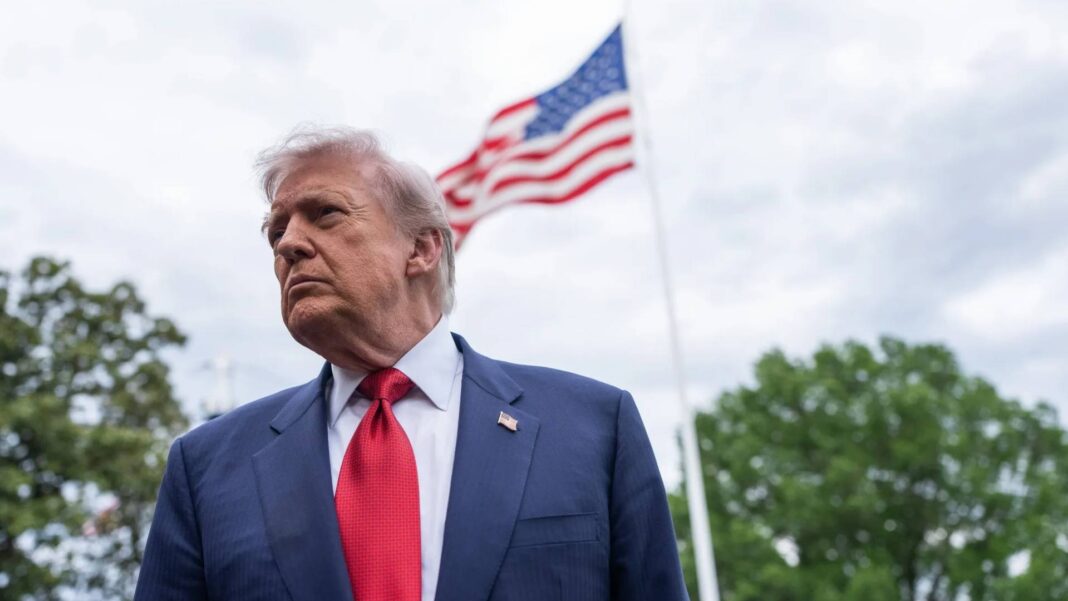

China announced on Monday that U.S. President Donald Trump is scheduled to visit Beijing from Wednesday to Friday for high-level talks with Chinese President Xi Jinping, marking the first trip by a sitting American president to China in nearly a decade. Beijing said it was ready to work with Washington in pursuit of “more stability” ahead of the meeting. The confirmation came as both governments face mounting friction over trade, Taiwan, and China’s ties to Iran.
Beijing’s foreign ministry spokesman Guo Jiakun told a regular news briefing that “top-level diplomacy plays an irreplaceable strategic guiding role in China-US relations.” He framed the visit as an opportunity to navigate deep bilateral tensions rather than resolve them outright.
“China is willing to work with the United States in the spirit of equality, respect, and mutual benefit, to expand cooperation, manage differences, and inject more stability and certainty into a volatile and intertwined world,” Guo said.
Pre-Summit Talks in Seoul
Before Trump and Xi meet in Beijing, their chief economic negotiators will hold preparatory talks in a third country. US Treasury Secretary Scott Bessent will meet Chinese Vice Premier He Lifeng in Seoul on Wednesday — the same day the presidential visit begins. Bessent and He Lifeng have served as the principal negotiators for both countries on trade and economic issues, and those Seoul talks are expected to finalise the substance of any announcements made at the leaders’ summit.
Bessent is travelling to the region with a packed schedule. He will first meet Japanese Prime Minister Sanae Takaichi in Tokyo on Tuesday before proceeding to Seoul. The Tokyo stop carries its own diplomatic weight: Takaichi’s comments in November on Taiwan triggered an ongoing diplomatic dispute with Beijing.
“Economic security is national security, and I look forward to a productive series of engagements as we work to advance President Trump’s America First Economic Agenda,” Bessent said as he announced both stops on social media.
The White House described Trump’s Beijing visit as being of “tremendous symbolic significance” and said Trump would “deliver more good deals” for Americans. The trip is expected to include a visit to the Temple of Heaven and a state banquet.
Iran Looms Large
Although trade tensions initially brought the two leaders together in October, the ongoing conflict in the Middle East is expected to take center stage during this round of discussions. China is one of Iran’s largest trading partners, and Iran’s foreign minister travelled to Beijing last week. Chinese Foreign Minister Wang Yi told his Iranian counterpart that Beijing would play a “greater role” in restoring regional peace.
According to US officials, Trump intends to press Xi directly on China’s position regarding the war. Guo, asked about that expected pressure on Monday, gave a measured response: Beijing’s stance on Iran remained “consistent,” he said, and China would continue to contribute in a “positive role” toward a ceasefire and peace negotiations.
The exchange comes against a backdrop of fresh US penalties targeting Chinese entities. The US State Department sanctioned three China-based satellite companies on Friday for allegedly enabling Iran’s military operations. The US Treasury Department separately sanctioned several firms based in mainland China and Hong Kong for aiding Iran’s weapons supply.
Beijing did not accept the measures quietly. The Chinese foreign ministry said Monday that Beijing “firmly opposes illegal unilateral sanctions.” The ministry added: “China has repeatedly made clear its solemn position. The most urgent task is to do everything to avoid the resumption of conflict, not to use the conflict to… maliciously smear other countries.”
Regional and Global Impact
The summit arrives at a moment of acute uncertainty across multiple fronts. US-China relations have deteriorated sharply over trade tariffs and technology restrictions, while the Middle East conflict has introduced a new set of flashpoints between the two powers. Washington’s decision to sanction Chinese firms in the days immediately before the summit signals that the Biden-era pattern of compartmentalising economic and security disputes has not carried over into the Trump administration’s approach. Beijing’s insistence that it will maintain a “consistent” position on Iran leaves little room for the concessions US officials are reportedly seeking.
For regional actors in the Middle East, the degree to which China backs US pressure — or resists it — on Iran’s war conduct will carry significant weight in any ceasefire negotiations.
Background
Trump last visited China in 2017, during his first term, making the upcoming trip the first by a sitting US president in nine years. Trump and Xi last met face-to-face in October on the sidelines of a regional summit in South Korea, where they agreed to a one-year truce in a trade war that had pushed tariffs on many goods above 100 percent. Trump’s visit to Beijing had originally been scheduled for late March or early April but was postponed so the administration could focus on the US-Israel war with Iran. Washington and Beijing have remained divided over Taiwan, which China claims as its own territory, and over the pace and scope of trade concessions.
What Happens Next
U.S. Treasury Secretary Scott Bessent and Chinese Vice Premier He Lifeng are scheduled to meet in Seoul on Wednesday to finalize arrangements ahead of the leaders’ summit. Trump then arrives in Beijing, where he and Xi are scheduled to hold talks through Friday. Any trade or economic announcements will follow from the Seoul groundwork. The US administration has made clear it will press China on Iran during those meetings. No formal joint statement has been confirmed ahead of the visit.